






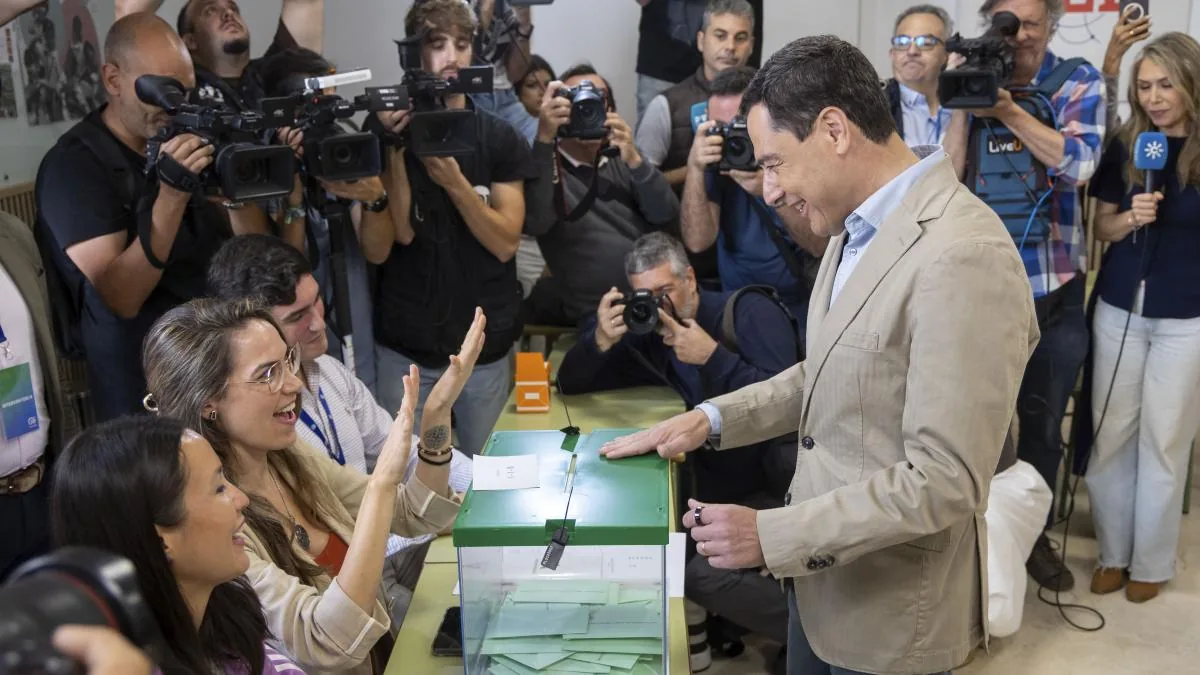
This election night is expected to be long, and not only because in at least three polling stations the day was extended by a few minutes due to late formation. The main reason is that, if the polls and the campaign teams’ calculations are correct, the result will not be decisive until almost the last vote has been counted.
It will also be extended because the dissemination of results and polls cannot be given until 8:43 p.m., as the formation of a table in a polling station in Seville was delayed by almost three quarters of an hour. As a result, the Andalusian Electoral Board has delayed the closing of the vote, and until this table is closed, data cannot be released.
The key to these elections is not who wins them. It is taken for granted that it will be the Popular Party, if not with how many deputies it wins and whether it manages to surpass the figure of 55 representatives that constitute the absolute majority of the Andalusian parliament.
As long as there are votes left to count, the last deputy assigned in each of the eight provinces can change parties.
The best way to understand this is to see what happened in 2022, when with only two tenths, just over seven thousand votes out of a total of 3.7 million votes cast, the PP candidacy was assigned four representatives and obtained the absolute majority with 58 deputies.
Also read
This happens because in each province, depending on participation and the votes each party receives, the cost in votes of each seat in Parliament is different. The higher the participation, the greater the number of votes each party needs to obtain a seat.
Read more Candidates for the Board take the ballot boxes on a key day for the future of Andalusia
Once the price of each deputy in each constituency is established, each party exhausts the reserves of votes obtained until the last one arrives. And what happens then? The one who has the most votes left in their bag takes the last deputy, even if it is by just one more vote.
Applying this mechanism to the eight electoral constituencies of Andalusia, it can be said that it is closer to a lottery than a count. The last vote of the smallest town can tip the balance and, in this case, give or take away the majority from the eventual winner, in this case the PP.
That is the story that will lead us to have to wait well into the night to know for sure if the eventual winner is also so by a majority that makes government pacts unnecessary. So, in short, there will be nerves until the end, unless the majority is so overwhelming that there is no longer any possible discussion. But, for now, this does not seem to be the case given the participation rates announced at 2 p.m.
Substantial increase in participation
The Andalusians are going to the polling stations in greater numbers than in the 2022 elections. Who does this benefit? We do not know, but we can note that, for example, some municipalities in Almería are voting even nine points – as is the case of the municipality of Balanegra, where, by the way, Vox was the second force ahead of the PSOE in 2022 – above the average from four years ago.
On the other hand, Jaén, a province more inclined to the PSOE, is having a harder time voting. It can be considered anecdotal, but in Chiclana del Segura, where the socialists won in 2022, participation is four points higher than four years ago, well below the average. Is it relevant? No. But it is what there is at this hour.
Read more Putin, from stumble to stumble