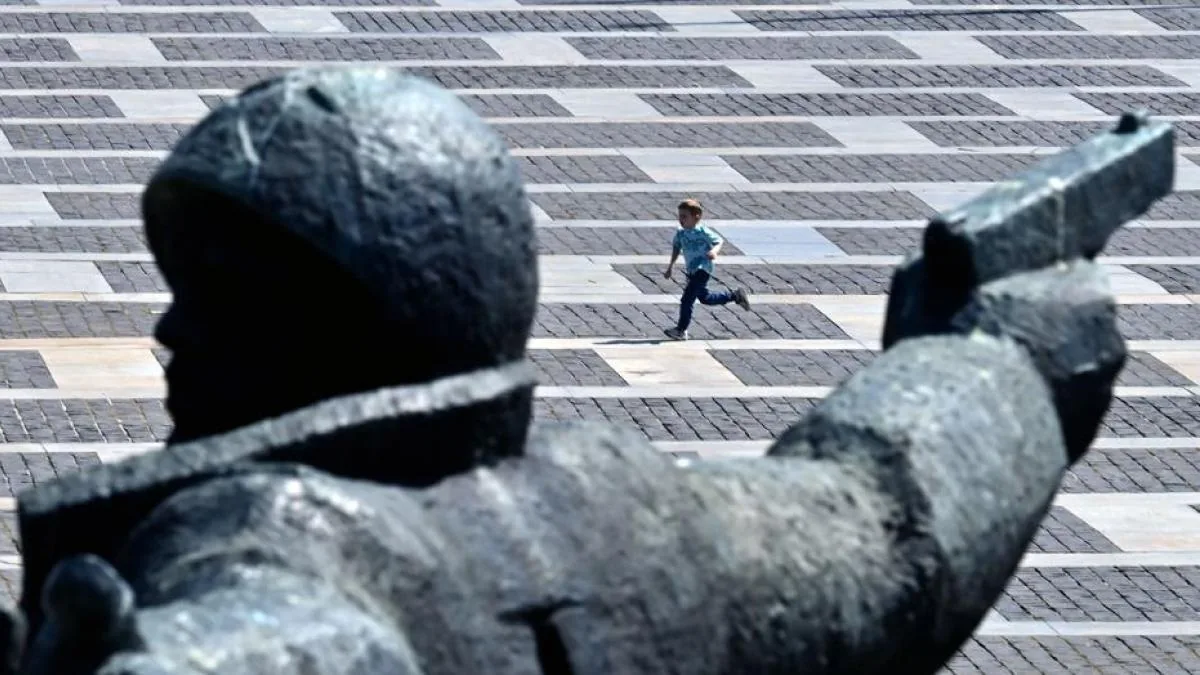
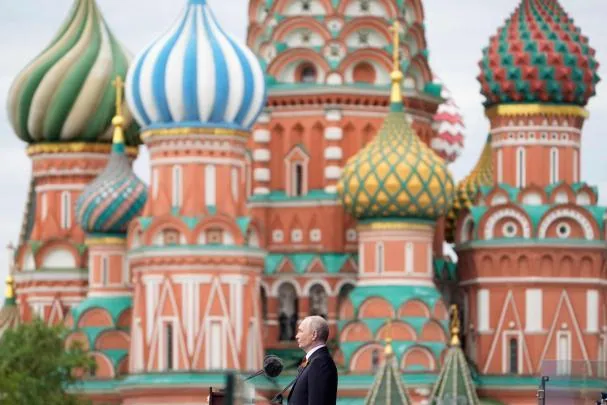
For Vladimir Putin, Victory Day had always been a source of pride. A day to show off military muscle. His best tanks and missiles, deployed in the heart of Moscow.
But this year, the parade in Red Square turned more into a humiliation for the Russian president.
The Kremlin not only had to forgo the display of heavy weaponry for fear of a Ukrainian sabotage, but also had to beg the White House to impose a temporary ceasefire to guarantee a peaceful May 9.
Volodymyr Zelensky complied with the truce but wanted to make it clear that he held the upper hand. In an unprecedented gesture, he issued a decree to “allow the celebration” of Victory Day and exclude Red Square from any attack. A real blow to Putin’s ego: Kyiv giving its authorization to Moscow to organize its big national party.
This episode would have been unthinkable four years ago, when Russia launched its “special military operation” in Ukraine, and it is symptomatic. It shows that Zelensky feels in a position of advantage.
“The dynamics of the war are changing,” said the head of European diplomacy, Kaja Kallas, last Monday, who assured that Ukraine is “in a much better position than a year ago,” while Russia is “weaker than ever.”
But is this optimism justified? Is there really a turning point happening in the war?
The analysis of what is happening on the front suggests yes.
After a very harsh winter for the Ukrainian population, with constant power and heating outages caused by Russian attacks on energy infrastructure, spring seems to smile on Kyiv.
In recent months, the Russian army has barely advanced. Not only that: according to the Washington-based Institute for the Study of War, in April Ukraine managed to liberate more territory than Russia conquered. Something that had not happened since the summer of 2024, when Kyiv carried out its incursion into the Kursk region.
These Ukrainian territorial gains are small (barely 114 square kilometers), and the Russian army still occupies about 20% of the country, but the data exposes the Kremlin’s inability to achieve its strategic objectives.
Likewise, Ukraine claims that Russia is losing more soldiers on the front than it can recruit. According to Kyiv, more than 35,000 Russian servicemen are casualties each month. A figure that, if true – the Kremlin does not report its losses on the front – would far exceed the number of new monthly recruits in the Russian army, believed to be between 24,000 and 30,000.
Several factors explain this Russian wear. The first, Elon Musk’s decision to block access to the Starlink satellite internet service for Russian troops deployed in Ukraine. The blockade, which came into effect in early February at Kyiv’s request, has greatly hindered Russian coordination on the front. For Moscow, the Starlink network was vital: it was used both to operate its drones and to facilitate internal army communications. This blow – added to the Kremlin’s decision to restrict the use of Telegram, where Russian officers shared tactical information – must be attributed to the new Ukrainian Defense Minister, Mykhailo Fedorov, who took office in January and maintains very good relations with Musk.
An expert in new technologies, Fedorov has set out to accelerate the modernization of the armed forces, promoting the use of AI – with the help of Palantir, a company present in all wars – and drones.
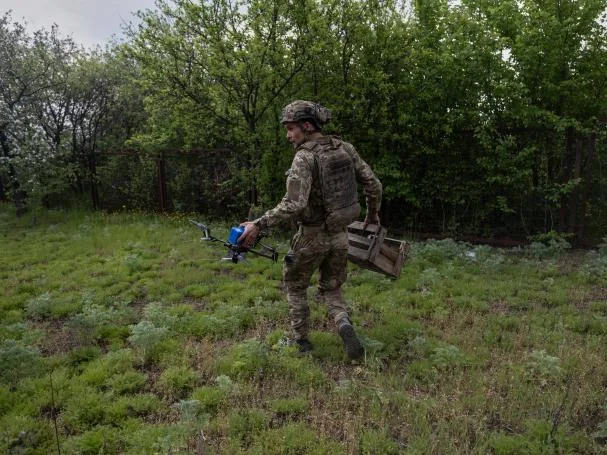
Precisely, the use of unmanned vehicles is another cause of the Russian collapse. Kyiv increasingly has more drones, and with them can reach further and further. In recent months, attacks deep in the Russian rear have followed one another, targeting energy infrastructure, ports, and refineries as well as command centers and arms manufacturing facilities. In fact, in March, Ukraine marked a milestone by surpassing Russia in the offensive use of long-range drones.
Read more Is being old being wise?
“This weakens Russia’s ability to wage war,” summarizes Orysia Lutsevych from the Chatham House analysis center in a phone conversation, who considers it practically “impossible” for the Kremlin to launch a major offensive this spring.
Drones have also helped alleviate one of the Ukrainian army’s big problems: the lack of soldiers.
“Just a couple of years ago, I wrote that Russia could win simply because it had more troops to send to the battlefield,” explains Tim Willasey-Wisley, a researcher at the Royal United Services Institute, via email. “However, what has drastically changed in recent months is that Ukraine no longer has troops in the so-called death zone, the 40-kilometer-wide front line. They have withdrawn forces from there and basically only use drones. This means the advantage is on the defender’s side,” details this academic.
Today, unmanned vehicles are responsible for up to 80% of Russian army casualties. And their lethality is rising: according to the Ukrainian government, if until last year Russian losses were divided into 35% dead and 65% wounded, now the percentages have reversed, with almost two dead for every wounded. Partly because it is difficult to evacuate soldiers from a front full of cameras, radars, and armed robots. Thus, any attempt to break Ukrainian defenses looks set to become a suicide mission.
The big question is whether Ukraine will be able to consolidate this favorable moment.
Jade McGlynn, a researcher at King’s College London, emphasizes that we are facing a very fluctuating scenario, “where the tactical landscape changes in a matter of months or weeks,” so saying that Ukraine has now taken the advantage “is more a contingent observation than a statement that the war has taken a fundamental turn.”
Likewise, this analyst believes that despite the drone revolution, the shortage of soldiers could undermine Kyiv’s progress. Desertions in the Ukrainian army are massive, and the population, exhausted after more than four years of conflict, resists joining the ranks. News about government corruption and struggles between different state factions, McGlynn adds, only deepen that demotivation. “These problems are important because they are inseparable from the social contract: what Ukrainians believe they are fighting for,” the expert opines.
Another possible obstacle is the United States, which since Donald Trump’s return has always been favorable to Kremlin interests.
“Washington could pressure Ukraine to reduce some of the attacks against Russia, and that would influence the battlefield,” says Orysia Lutsevych. Researcher Tim Willasey-Wisley agrees: “Ukraine is mostly worried about Trump. If Trump completely withdrew his support for Ukraine, it would be a severe blow.” That forces Zelensky to act cautiously, although now the Ukrainian president has more room to maneuver than a year ago: Viktor Orbán’s departure from the Hungarian government guarantees him firmer support from the European Union.
And then there is Russia’s possible reaction. “It is dangerous to underestimate the enemy,” says Lutsevych. “One can always expect the Russians to have some strategic innovation up their sleeve,” the analyst opines, recalling that in recent years Moscow has already demonstrated its adaptability, developing solutions such as fiber-optic controlled drones.
Meanwhile, Putin remains convinced he can win. His generals assure him that the Ukrainian army is about to collapse and that the total conquest of Donbass could be a reality by autumn.
Thus, despite saying on May 9 that the war “is coming to an end,” the Russian president avoids any attempt at de-escalation: this week, after the end of the brief truce imposed by Washington, Moscow has carried out brutal bombings on Kyiv.
Unfiltered attacks from an autocrat who seems oblivious to the reality of the battlefield and who refuses to accept that today victory is far from the Kremlin.
Read more The lost power of the Bernabéu box