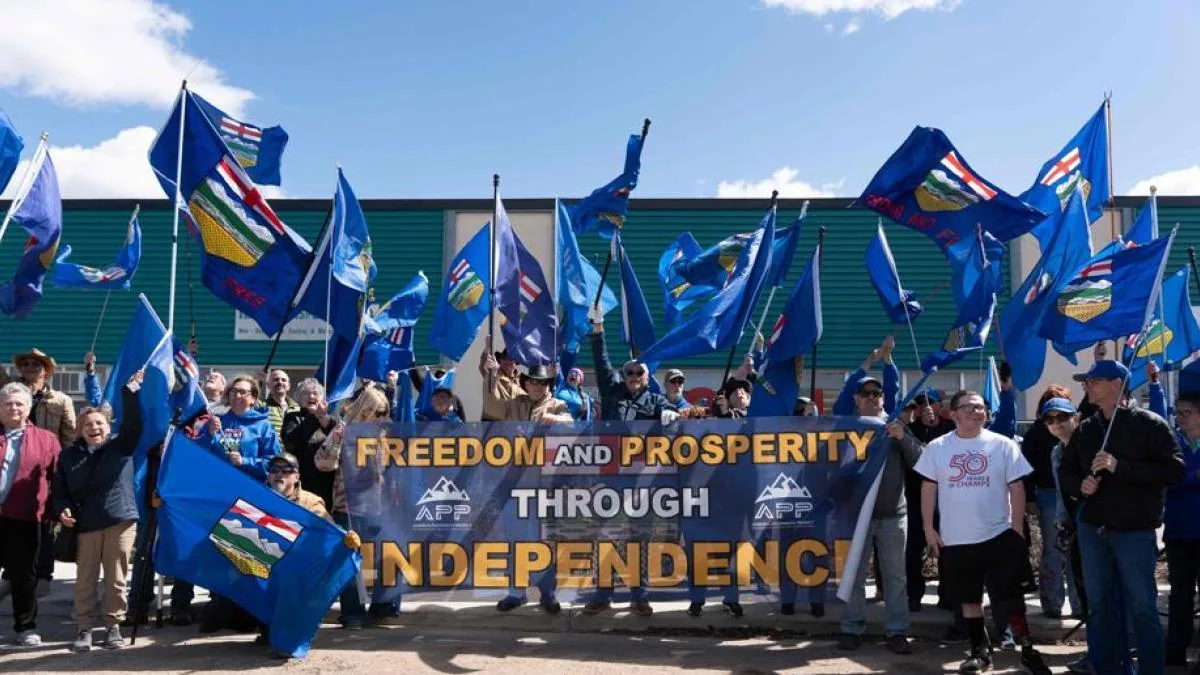
Do you agree that the province of Alberta should stop being part of Canada to become an independent state? This is the question that many voters in this region, bordering the United States, will have to answer after the separatist group “Stay Free Alberta” collected the necessary signatures to call a referendum. 178,000 were needed; they got 300,000. This fact marks a before and after for the province, which sees its secessionist aspirations approaching under the watchful eyes of Washington and Moscow.
Read more Canada, Europe’s best friend across the Atlantic
The desire for freedom in this region is a movement that has existed in Canada for decades, but it has gained momentum in the last year, after the victory of the Liberal Party, led by Prime Minister Mark Carney, in the federal elections. Alberta is the fourth most populous province in the country and one of the richest. Its appeal, beyond the lush forests and vast lakes that attract tourists from all over the world, lies in its natural resources. Its geographical location is key for the exploitation of coal, gas, and oil deposits, making it the largest crude oil exporter in the nation.
The province produces more than 80% of Canadian oil and 60% of its natural gas. It contributes 15% of the national GDP despite representing only 12% of the population, but it does not receive payments from the federal equalization system that benefits provinces like Quebec or Manitoba. Many Albertans believe that Ottawa imposes environmental regulations, a carbon tax, and obstacles to pipeline construction that limit their ability to export energy, while the wealth generated in the province finances the rest of the country without an equivalent return.
U.S. officials have met multiple times with the separatists
To this structural discontent is now added an unprecedented geopolitical factor: the alleged interference of the Trump administration. U.S. State Department officials have met at least three times with the Alberta Prosperity Project, the group promoting the referendum, and Treasury Secretary Scott Bessent publicly described Alberta as “a natural partner for the U.S.,” fueling separatist hopes. The movement’s leaders have requested a $500 billion line of credit from Washington to support the province if the referendum succeeds, a request to which Prime Minister Mark Carney has responded by demanding respect for Canadian sovereignty.
Adding to this scenario is the figure of Russian President Vladimir Putin. A study released by the Global Center for Democratic Resilience, along with the Center for Artificial Intelligence, Data and Conflicts and DisinfoWatch, states that both Washington and Moscow are intervening in the separatist debate. According to the report, internal tensions are being amplified and narratives affecting the country’s democratic integrity are being promoted through social networks and information infrastructures aligned with the Kremlin. The goal would be to exploit real grievances, such as the perception of economic exploitation or lack of political representation. There are even cases of U.S. influencers and former Trump administration officials who have publicly supported the secessionist movement.
Read more U.S. considers prosecuting Raúl Castro, whose grandson met in Havana with the CIA director
An unprecedented data leak has shaken the democratic foundations of the province: the Centurion Project, a group linked to the separatist movement, illegally accessed the official voter list of Alberta, which contains names, addresses, and contact details of nearly 2.9 million people. The database lacked any protection: anyone with an anonymous account could download the complete files, and nearly 600 people did so. Behind the project is David Parker, a veteran political organizer with ties to figures of the U.S. MAGA movement like Tucker Carlson, and with a previous record of fines for electoral law violations. The software supporting the tool was developed by a U.S. company and, according to its creator, was even presented at the Trump White House.
Polls indicate that only 20% would vote in favor of independence
However, the process has suffered an unexpected judicial blow. Judge Shaina Leonard, of the King’s Bench Court, has annulled the referendum request by determining that the Alberta government had the obligation to consult the First Nations before allowing the collection of signatures. Two Indigenous groups argued that any secession would violate historical treaties signed with the Crown, predating the very creation of Alberta as a province. “This decision should close the chapter on the suggestion of an independence referendum. The court has spoken, and so have the First Nations,” said Chief Allan Adam.
The ruling also comes at a time when real support for independence is more nuanced than headlines suggest: recent surveys indicate that about a third of Albertans would support starting the process, but one in five of those supporters sees it more as a protest gesture than a firm will to found a new country. Premier Danielle Smith, however, promised to appeal the ruling, calling it “legally incorrect and undemocratic,” while separatist leader Mitch Sylvestre is pushing for the government to include the question directly in the October referendum by other means. We do not know if Alberta will achieve its independence, but what is certain is that the road to the polls has become much more tortuous than the 300,000 signatories expected.