No agreement and a new meeting next Tuesday. The sectoral table meeting between the Generalitat’s Minister of Education and Vocational Training, Esther Niubó, and the unions – Ustec·Stes, Aspepc·Sps, CC.OO. Educació, CGT Ensenyament, and UGT, with Intersindical added – ended without agreement but with the commitment to resume talks next Tuesday. The meeting was supposed to address issues such as resources for inclusive schooling and teachers’ salaries.
Read more Latvian Prime Minister resigns amid government crisis following incident with Ukrainian drones
Minister Niubó wanted to present progress regarding inclusive schooling (1,066 more professionals for the next school year), but union representatives present at the meeting stood firm on the issue of remuneration.
The ministry committed to preparing a proposal for next week and called on the unions to meet again on Tuesday. The unions not signing the educational pact declared, after the meeting, that they will not meet again unless there is a proposal that improves working conditions.
In this regard, the Secretary of Educational Improvement of the Generalitat, Ignasi Giménez, defended that the signed educational pact, worth 2 billion euros over four years, is sufficiently “broad, open, and flexible” to explore its margins without needing to reopen the pact.
Fernández expressed satisfaction at having found a “space for dialogue” and with how the meeting unfolded, in which “the foundations were laid to be able to work in the coming weeks and open ways to find this necessary outcome.”
The secretary avoided talking about salaries and referred to “labor improvements,” recalling that in this May’s payroll teachers “will already notice the increase,” with the payment of more than 800 euros, as well as the supplements for educational support staff. He also did not want to respond to the economic effect that the possible approval of the budget might have on salaries. “We will explore other elements related to improving the conditions of educational sector staff, because there is room with this country agreement, of more than 2 billion euros, to find elements and measures that allow exploring possibilities to generate the necessary consensus to reduce tension,” he explained.
The spokesperson for Ustec, Iolanda Segura, warned after the meeting that “we will only sit down to negotiate if we receive a concrete proposal on the remuneration schedule and resources for inclusive education on Monday.” Segura specified that a new negotiation framework is necessary because the agreement made with CC.OO. and UGT, as drafted, does not allow negotiating labor improvements as is the case in the field of inclusive schooling.
Segura clarified that everything must be addressed, not just salaries, but that “there are many elements on the table to negotiate because teachers have been suffering a loss of purchasing power in recent years.”
Read more The secret war of Saudi Arabia and the United Arab Emirates against Iran
On the other hand, the representatives of CC.OO. and UGT, Lorena Martínez and Ester Guillamet, respectively, who welcomed that all unions are at the table again, believe that the agreed pact allows room to negotiate both salaries and inclusive education. Because of its flexibility and openness. As well as the implementation timelines. In this regard, UGT has requested the return of the stadium debts.
For his part, the representative of Secondary Teachers (Aspepc·Sps), Ignasi Fernández, considered the proposal an “insult.” This union does not agree with allocating so many resources to inclusive schooling, whose model they consider does not work. It is not that they refuse aid to attend to student diversity, but they believe the model must be redesigned. They advocate, therefore, for salary increases and improved working conditions such as payment of the stadium debts.
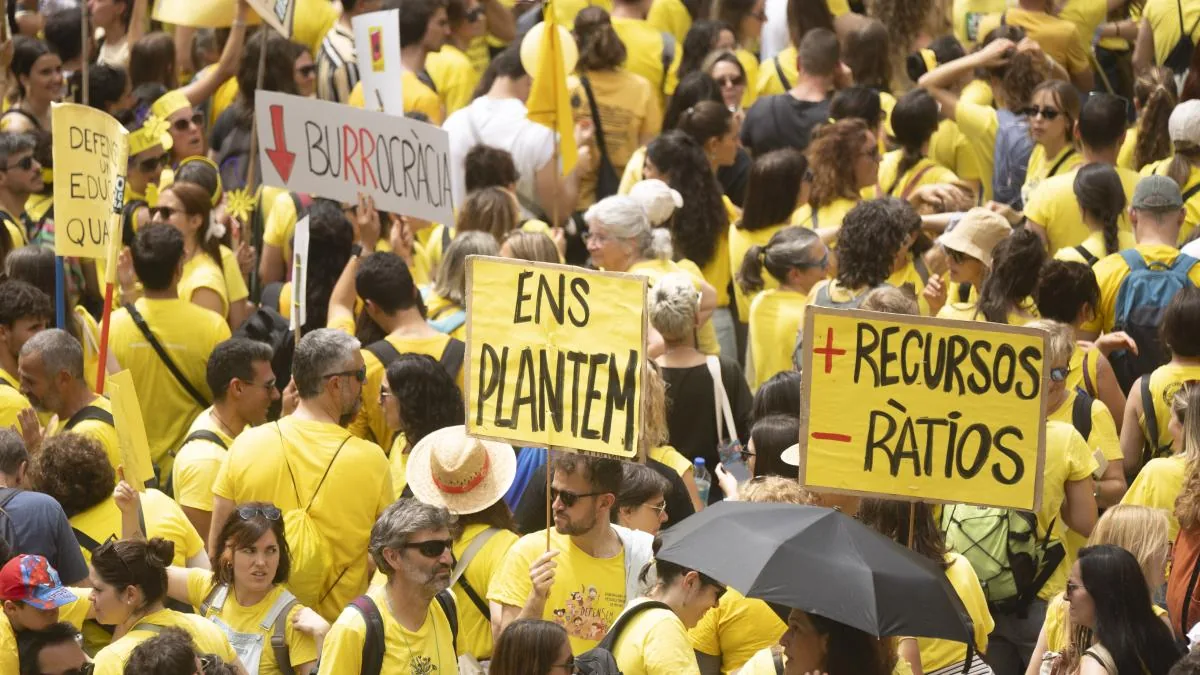
Laura Gené, from CGT, demanded a proposal in line with street mobilization. “There is an educational emergency situation and the department must do everything possible to resolve the conflict.” That proposal must include salary increases, reduction of ratios, and an increase in professionals to attend to inclusive schooling “and not the crumbs they have offered us.”
In this regard, the minister started from the proposal of 1,066 more professionals next school year, 60% of whom would be for inclusive education. Last week the Government agreed on the entry of 509 professionals.
The meeting took place at the headquarters of the Ministry of Education, on Via Augusta in Barcelona, and occurs amid the third day of territorially localized educational strike in Girona and central Catalonia.
Meeting two months after the pact and after eight days of strike
Two months after the educational pact and the break with the non-signatory unions, and after eight days of strike, unions and Government sat again at a sectoral table to negotiate.
On the department’s side, the Secretary General, Teresa Sambola, and the Secretary of Educational Improvement, Ignasi Giménez, attended; and union sources indicate that Educació also called Intersindical to the meeting, a union that, although it has no representation in the sectoral table, is one of the organizers of the strike cycle, along with Ustec·Stes, Aspepc·Sps, and CGT Ensenyament.
Read more The British Health Secretary resigns to run as a candidate against Starmer