









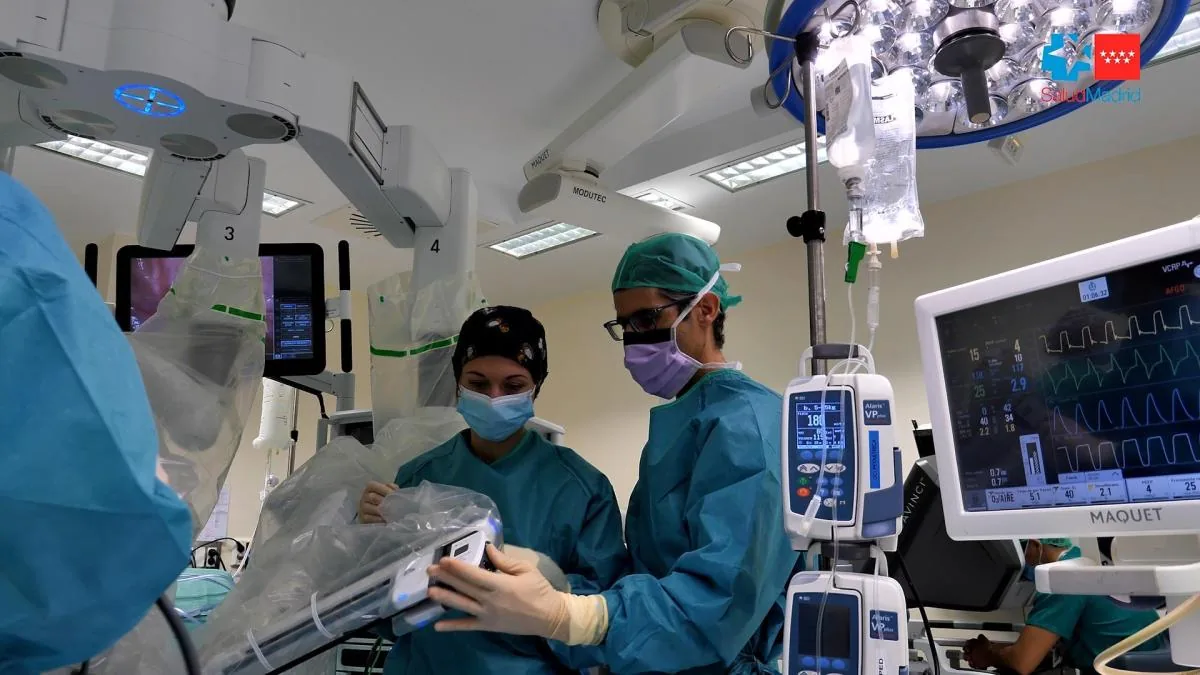
Professionals at the 12 de Octubre Hospital in Madrid have successfully performed robotic surgery on a baby just three months old who had a kidney obstruction, the first intervention of this type in Spain on a patient so young with this kidney disease.
Specifically, the baby had an obstruction in the kidney area that prevented urine from flowing normally to the ureter and bladder, which was progressively affecting kidney function, according to the regional government.
Discharged in 48 hours
Thus, with the robotic surgery carried out by the professionals of the Pediatric Urology Section, integrated into the Pediatric Surgery department of the center, they managed to remove the narrowed area and reconstruct the urinary tract, reconnecting the kidney with the ureter to restore proper flow.
After the surgical procedure, the baby showed a very favorable evolution that allowed discharge 48 hours later, without any complications during the operation and immediate postoperative period.
Currently, follow-up tests are being performed to confirm the results of the reconstructive urinary tract surgery. In this regard, preliminary data are positive, indicating that the obstruction has been corrected and that the kidney is draining urine properly. THE OPERATION
A challenge for pediatric patients
The use of robotic surgery in pediatric patients poses significant challenges, especially in the smallest ones, as surgeons must operate in very small anatomical spaces using instruments that, in many cases, were originally designed for adults.
“Working in the abdomen of a three-month-old patient means moving in very small spaces where the kidney measures approximately 5 centimeters in size, about the size of a plum,” explained pediatric surgeon Daniel Cabezalí.
Thus, this procedure requires extreme precision. In fact, to date, these interventions in such small patients remain very rare worldwide, with only a few cases previously described in Asia.
They also require perfect coordination among all involved professionals, such as surgeons, anesthetists, and nursing staff, since the joint and well-synchronized work of all of them is essential to ensure patient safety and achieve good results.
For it to be successful under these conditions, it is also essential to take advantage of the benefits offered by robotic technology. Among them, the pediatric surgeon highlighted image magnification, three-dimensional vision, and great precision in the surgeon’s movements.
All this allows greater accuracy in delicate reconstructive procedures, increasing the chances of success and improving outcomes for the patient.
50 robotic surgery procedures
This type of intervention performed with the Da Vinci robot consolidates the 12 de Octubre Hospital as a national reference center in high-complexity pediatric surgery and the use of this technology. So far, it has carried out more than 50 robotic surgery procedures.
Furthermore, this advance allows progressively expanding the possibilities of robotics, applying it to increasingly complex procedures and in younger and smaller children.
Thanks to this accumulated experience, the regional government has emphasized that the Pediatric Surgery service has demonstrated that the use of this equipment is not only applicable but especially beneficial in pediatric patients just a few months old.