









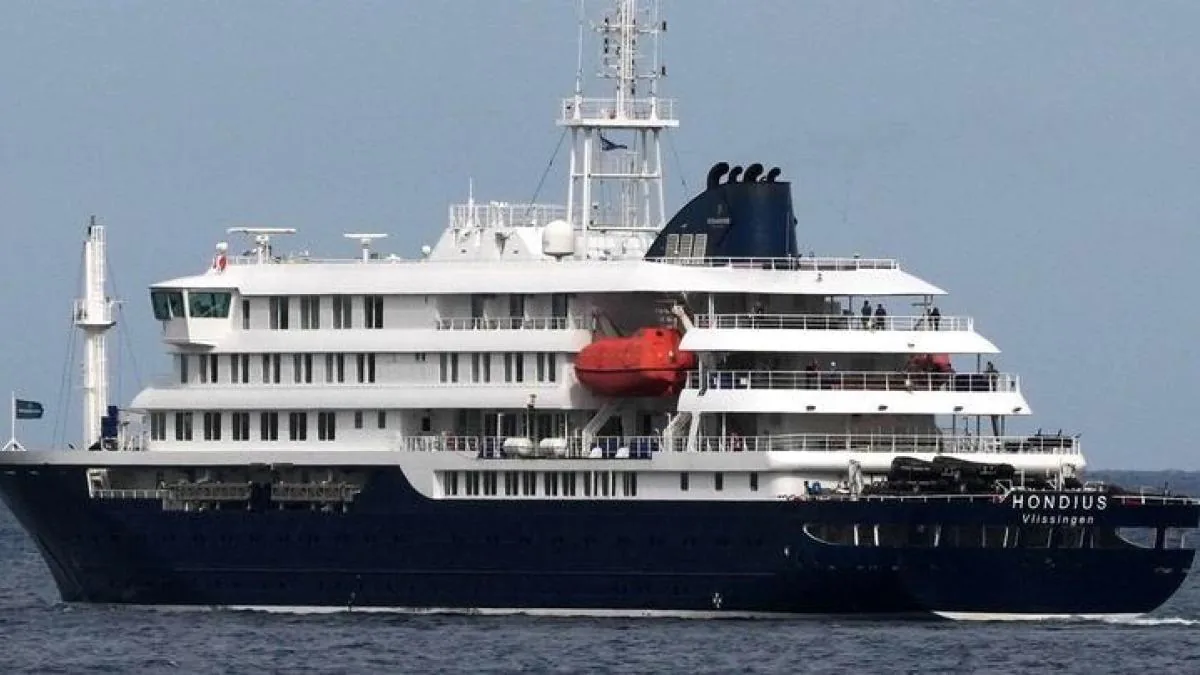
The MV Hondius cruise ship is at the center of a hantavirus outbreak declared between April and May 2026. Of the 147 passengers on board, from 23 different nationalities, 9 cases have been recorded —6 confirmed and 3 suspected—, 3 of them fatal. Among those affected are 14 Spaniards: 13 passengers and one crew member.
Read more The WHO addresses Canarian society to reassure them: “This is not another covid-19”
The origin: a landfill in Argentine Patagonia
The outbreak originates on land, before the ship set sail. A Dutch couple is believed to have been exposed to the virus while birdwatching near a landfill in Ushuaia, Argentina, shortly before boarding on April 1, 2026. Hantavirus is transmitted to humans through the urine, droppings, or saliva of infected rodents, specifically the long-tailed mouse (Oligoryzomys longicaudatus), a species present in South America. Hantaviruses are not usually transmitted between humans: the only documented exception to date is precisely the Andes strain, the one involved in this outbreak.
How the virus acts in the body
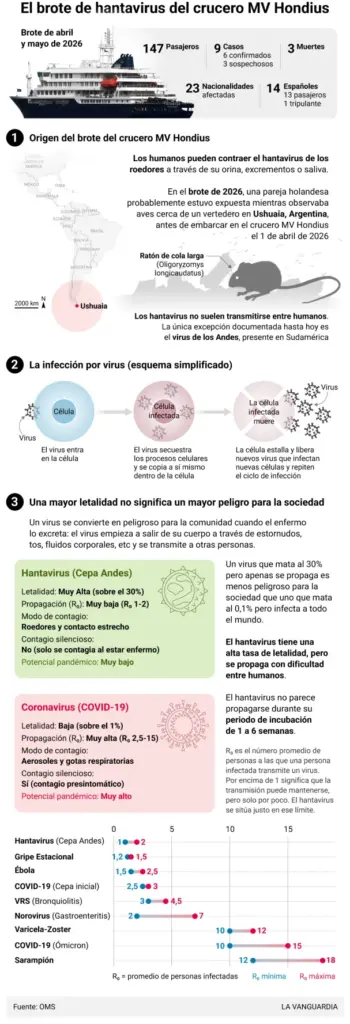
Once the virus enters a cell, it hijacks its internal processes to replicate. The infected cell eventually dies and releases new viruses, which infect new cells and repeat the cycle. This mechanism, common to many viruses, explains the severity of the infection but does not alone determine the risk it poses to society.
What is the real risk?
High lethality, but low spread
The most important characteristic of hantavirus —which radically differentiates it from COVID-19— is the combination of its high lethality and very low capacity for spread. The Andes strain kills about 30% of those infected, but its reproduction rate (R₀) is between 1 and 2, meaning each infected person infects on average barely one or two more people. Furthermore, the virus does not seem to spread during its incubation period, which lasts between 1 and 6 weeks, further limiting its capacity for silent expansion.
Read more Unprecedented deployment to contain the hantavirus outbreak from the ‘Hondius’ in Spain
COVID-19, on the other hand, has a lethality below 1%, but an R₀ between 2.5 and 15 depending on the variant, and is transmitted presymptomatically through aerosols. That is what gave it a very high pandemic potential. Hantavirus, with a spread barely above the minimum sustainability threshold, has a very low pandemic potential.
In other words: a virus that kills 30% but barely spreads is less dangerous to society than one that kills 0.1% but infects everyone.
Read more They send for analysis the sample from a woman admitted in Alicante due to contact with Hantavirus