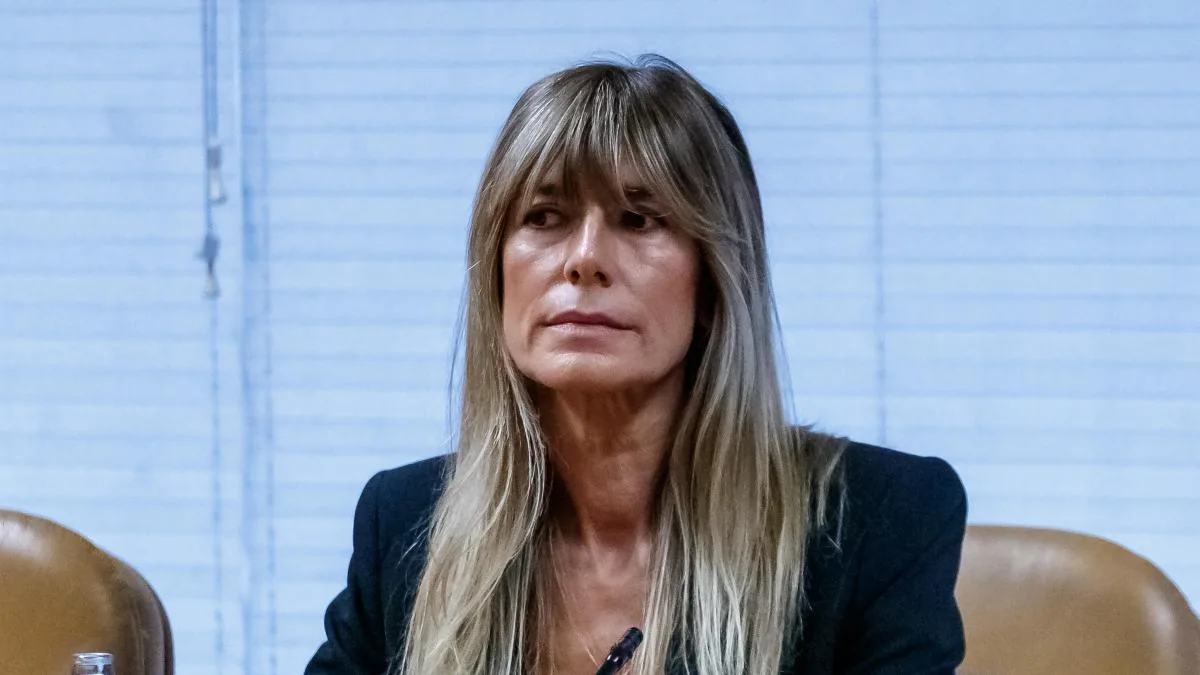
The popular prosecution led by the ultra-conservative organization Hazte Oír in the Begoña Gómez case has requested 24 years in prison for the wife of the Prime Minister for the four crimes proposed by Judge Juan Carlos Peinado, as well as a ban on leaving the country and the confiscation of her passport due to “risk of flight.” It also requests 22 years for her advisor, Cristina Álvarez, and six for businessman Juan Carlos Barrabés. For her part, Pedro Sánchez’s wife has filed a complaint with the Madrid Court against the investigation carried out by Peinado, asking for his decision to close the investigation and prosecute her to be declared null and void, as she believes her defense rights have been violated.
Read more The revenge of the pensioner Luis Bárcenas
In its indictment, Hazte Oír requests —on behalf of the various popular accusations in the case— the opening of an oral trial against Sánchez’s wife for alleged crimes of influence peddling, business corruption, embezzlement, and misappropriation.
The popular prosecution considers that there is “an evident and well-founded risk of flight” on the part of the three investigated individuals
The organization considers that there is “an evident and well-founded risk of flight on the part of the three,” and therefore requests that, as precautionary measures, they be prohibited from leaving national territory without prior judicial authorization, have their passports withdrawn, and be obliged to sign every fifteen days at the courthouse.
Hazte Oír states that after Pedro Sánchez became Prime Minister in 2018, Begoña Gómez, “fully aware of this and voluntarily, made a radical change” in her career, taking advantage of the influence granted to her by being the wife of the head of the Executive.
Thus, this association states, Gómez managed to direct a professorship at the Complutense University, a job in which she was helped by businessman Barrabés, for whom she, in return, signed letters in favor of his projects so that he would receive aid.
They add that once in that position, Gómez misappropriated ‘software’ from the Complutense and managed to have Cristina Álvarez appointed as her advisor for private tasks with her connivance.
Requests Sánchez and Bolaños to testify at the trial
For the trial, it requests that a hundred witnesses appear, including the Prime Minister, and also the current Minister of the Presidency and Justice, Félix Bolaños, whose testimony “is crucial to clarify the appointment of Cristina Álvarez and the functional scope of the position.”
This past Saturday, the organization Manos Limpias, as a popular prosecution, requested 10 years and three months in prison for the Prime Minister’s wife: eight years in prison for alleged embezzlement, plus two years and three months for influence peddling, in addition to “a fine double the economic benefit obtained.”
Begoña Gómez’s brief against Peinado
On the other hand, the brief presented by Gómez’s defense argues that her fundamental rights have been violated, especially her right to defense, denies that there are solid indications of any of the four crimes, and questions the judge’s proposal to try her by a jury without providing arguments.
The brief questions the judge’s decision to conclude the investigation prematurely, without allowing the parties to request new evidence and without waiting for appeals on previous orders to be resolved, an “evident” violation of the right to defense.
Read more Trump confirms Vance travels to Pakistan today for his second round of dialogue with Iran
Regarding the crimes attributed by the judge to Gómez, the brief focuses on influence peddling and emphasizes that it is based on the thesis that Gómez used her relationship with the Prime Minister to influence the rector of the Complutense University to create a professorship, but “it does not provide a single indication that this actually occurred.”
In fact, it attacks the judge’s mention that Gómez was paid for that professorship, which reflects “either a conscious fallacy or the utmost disinterest in what each and every one of the UCM officials who came to testify have reported: all have maintained that the Professorship was completely free and the regulations governing it establish this.” “It gives the impression that an objective is being sought, even at the cost of massacring the truth,” adds the defense of the wife of the head of the Executive.
A similar approach is taken regarding Peinado’s allusions to the sponsors of the professorship as a “facade” for a covert remuneration “for future undue private or commercial advantages, related to public contracts linked to the position of Prime Minister.”
In his opinion, that statement is not proof of anything, nor an indication, but rather a hypothesis related to the Prime Minister, “who has become the person behind all the instructor’s theses in his objective of building a parallel reality, disregarding everything done after almost two years of investigation, almost 30 volumes of the case, and dozens and dozens of statements given.”
The brief insists on highlighting the judge’s “merely subjective assessment,” who “converts his personal conjecture into a supposedly incriminating element.” “Facts are not interpreted. Rather, reality is subjectively recreated to give it a non-existent appearance of criminal unlawfulness,” it argues.
In this regard, it complains that he attributes the crime of influence peddling to Gómez solely for being the wife of the Prime Minister and that he takes into account that she met with her interlocutors in the Palacio de la Moncloa, ignoring that it is her home.
It also questions Peinado’s decision to take the procedure to a jury trial without sufficient reasons to do so and argues that, in reality, the judge adapts reality and stretches criminal types to fit the case.
For her part, Cristina Álvarez, Gómez’s advisor, has also filed a complaint with the Provincial Court of Madrid, insisting that the case against her be dismissed and arguing that she cannot be tried by a jury.