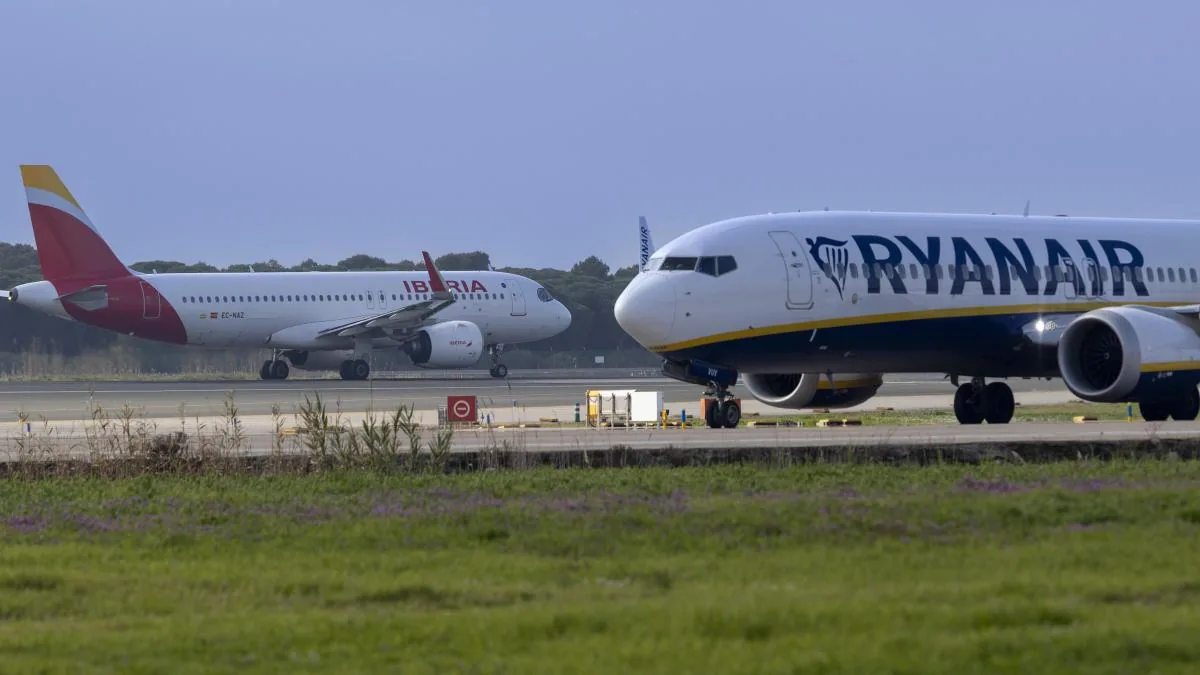
Air transport faces a situation of maximum uncertainty on the eve of summer due to the war in the Middle East. As much as airlines and the tourism sector in general strive to project a public image of calm, the reality behind closed doors is one of great concern about the real risk of aviation fuel shortages in the coming weeks. The airport association, ICE, warns of supply problems in just two weeks, and the International Energy Agency (IEA) estimates that in little more than a month there will be a lack of kerosene in Europe.
Read more The transfer of Venice
“It’s the Hunger Games,” says an authorized voice from the industry in Spain, who requests anonymity, to describe the companies’ race to stock up on fuel in an unprecedented situation. The temporary reopening of Hormuz may provide some oxygen, but the damage to the Persian Gulf refineries will not be resolved immediately, and supply would take time to normalize even when tankers return to cross the strait without restrictions. The European Commission’s warning for companies to avoid business travel by plane is by no means gratuitous.
Some of the main airlines have scheduled their strategy, which they will deploy depending on the severity of the situation. The first action, if there are no significant increases in fuel reserves, will be a palpable price hike by mid-May to compensate for the rising cost of energy. In the case of kerosene, costs have climbed above the crude oil barrel, which has reached 150 dollars.
“It’s the Hunger Games,” the sector states to describe the race for fuel
Companies like Ryanair and EasyJet have been the first to openly admit that the rise in airfares “is inevitable,” and some have already started applying surcharges to cover the additional costs of flights. The deterioration of the income statement is taken for granted.
Should the fuel shortage persist, as expected, airlines will begin to implement “surgical” flight cancellations, according to business sources. That is, cuts to non-strategic flights to save fuel and costs. Spanish airline Volotea has already applied a 1% capacity reduction for this reason, while KLM and Lufthansa groups have also canceled flights for April and May in some of their subsidiaries. “More airlines will be affected,” the companies warn.
Read also
The availability and price of aviation fuel vary by region. Given the current geopolitical volatility, “it is complex to predict the evolution of the conflict, so it is necessary to analyze the situation through scenarios,” states Pere Suau-Sanchez, a professor at the UOC.
Read more United States attacks an Iranian ship and Tehran suspends peace negotiations
Companies foresee price increases, ‘tankering’, and capacity reduction in the event of an escalation
This expert in the airline industry highlights that, in the short term, no problems are observed in Europe. “Traffic figures reached record levels in March and maintain a positive trend in April,” he emphasizes.
However, he believes that such a situation will inevitably impact airlines. “In the medium term, although many European companies have financial hedges that protect up to 70% of their consumption against price increases, the magnitude of current increases makes it difficult to compensate for the cost of the uncovered portion,” he points out. Each airline, depending on its market, will apply a combination of measures to gain resilience: seeking internal efficiencies, progressively adjusting prices, making tactical cancellations, or resorting to tankering (loading fuel for the round trip), Suau-Sanchez explains.
Read also
For Michel Bove, director of corporate ratings at Scope Ratings, Mediterranean-based airlines that rely on fuel supplied by tankers face a “substantially higher” risk of disruption than northern companies, with operational hubs fed by pipelines.
“Spain presents a kerosene shortage problem higher than the European average,” analysts warn
Around 20% of kerosene supply is affected by the blockade of the Strait of Hormuz and export restrictions in Asian countries. However, this does not mean that 20% of air operations must be canceled. “There are various ways to cover, at least in part, the supply shortage,” clarifies Rogier Lieshout, an aviation economist at Beelining consultancy.
Even so, not all countries start from the same position. According to Lieshout, Spain presents a higher risk of shortage than the European average: it has moderate production capacity, but with limited reserves, many of which are not available for immediate commercial use. Added to this is a forecast of strong tourist demand this summer, which could intensify pressure on supply due to the diversion of travelers from Middle Eastern destinations and intercontinental routes. The appetite for travel remains, but the sector faces a critical unknown: having the necessary fuel to sustain the high season.
Read more All at once in Barcelona