It seems like centuries have passed since the days when representatives of the Trump administration arrived in Rome received with all honors, while ministers competed to get a photo with them. Marco Rubio, on the other hand, lands in the Italian capital in a low-profile atmosphere bordering on distrust. The Secretary of State’s mission, already complicated in itself, has become even more arduous after Donald Trump’s new accusations against the Pope regarding the Iranian nuclear program, to which Leo XIV responded firmly on Tuesday night.
The agenda foresees a morning audience with the Pontiff at the Vatican on Thursday, followed by a meeting with the Holy See’s Secretary of State, Cardinal Pietro Parolin. On Friday, however, the rapprochement operation will be dedicated to Italy, a country with which relations have notably worsened. The meeting with Prime Minister Giorgia Meloni is scheduled for 11:30.
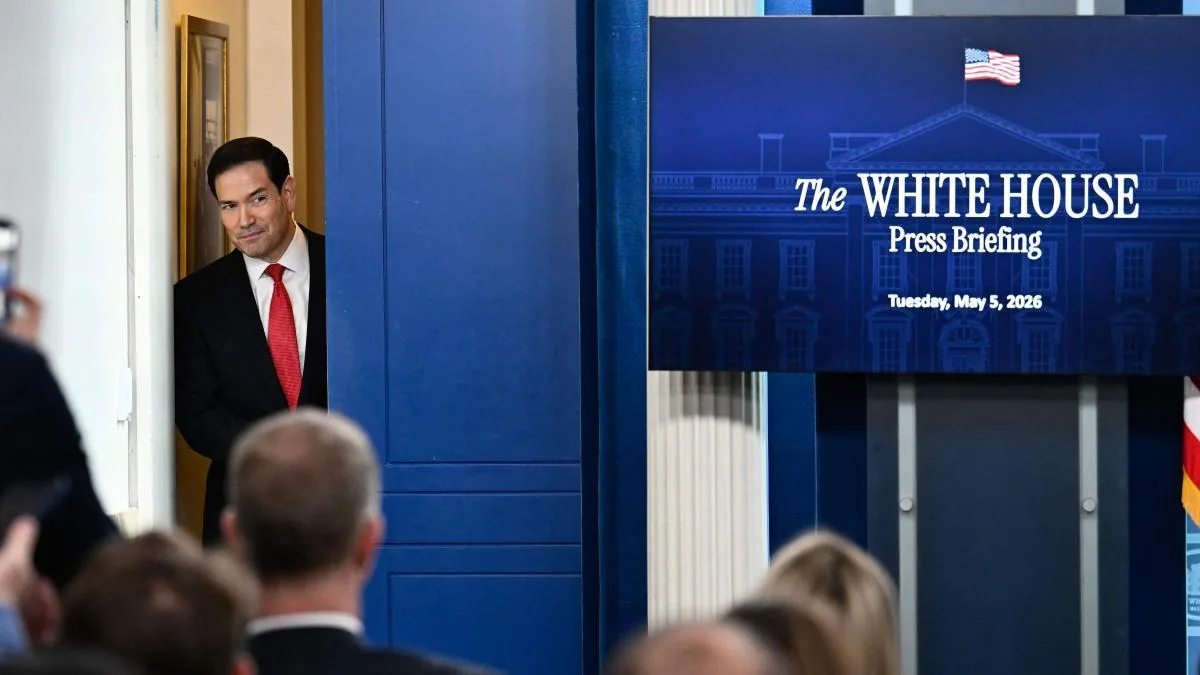
The Vatican, despite Trump’s new offensive remarks, has decided to keep the appointment. And on both banks of the Tiber, the religious and the political, many wonder what the real purpose of Rubio’s mission is. Trump’s own statements against the Pope have cast doubt on whether the Secretary of State arrives in Rome with a clear mandate to mend the relationship with the Church and with Italy. And then the question circulating through the Roman palaces arises: Is Rubio trying to build his own space or even act as a mediator between Trump and Italy? That impression was reinforced by last Tuesday’s long press conference, in which the Secretary of State appeared much less impulsive than other members of the administration.
The U.S. Strategy
In the Roman palaces, doubt grows about whether Rubio arrives with a mandate from Trump or tries to open his own channel
The topics of the meeting with the Pope will inevitably intersect with those that have caused controversy with Trump, starting with the wars. A first sign will be the duration of the audience: in principle, Rubio has half an hour, since at 12 the Pope has another commitment. But precisely that detail will be closely watched. Leo XIV appeared confident before the meeting and appealed to “openness” and mutual “understanding.” But in principles, there is no room for ambiguity: “The Church — he said on Wednesday speaking to the faithful in St. Peter’s Square — has the mission to pronounce clear words to reject everything that mortifies life and prevents its development, and to take sides for the poor, the exploited, and the victims of violence and war.”
And yet, in the Vatican no one pretends that nothing has happened. The wound caused by the U.S. president’s accusations is evident, starting with that of having accepted the Iranian nuclear rearmament. Those attacks “are at least strange,” Monsignor Parolin said without hiding his surprise as he entered the presentation of a book about the Pope. “The Holy See has always worked and continues to work for nuclear disarmament, so it cannot accept even the suggestion that it supports the legitimacy of nuclear weapons.”
The Vatican Secretary of State
Washington’s accusations “are strange: the Holy See has always worked for nuclear disarmament,” says Parolin
Ultimately, everything suggests that Rubio will have to give explanations about what happened. “We will talk about everything that has happened these days. It is impossible to avoid these topics,” explained the Vatican Secretary of State. But the real backdrop is above all Venezuela and Cuba, central dossiers on Rubio’s agenda. “Our proposal — Parolin concludes — remains always that of dialogue. Conflicts are not resolved with force, but with negotiation and political will.”