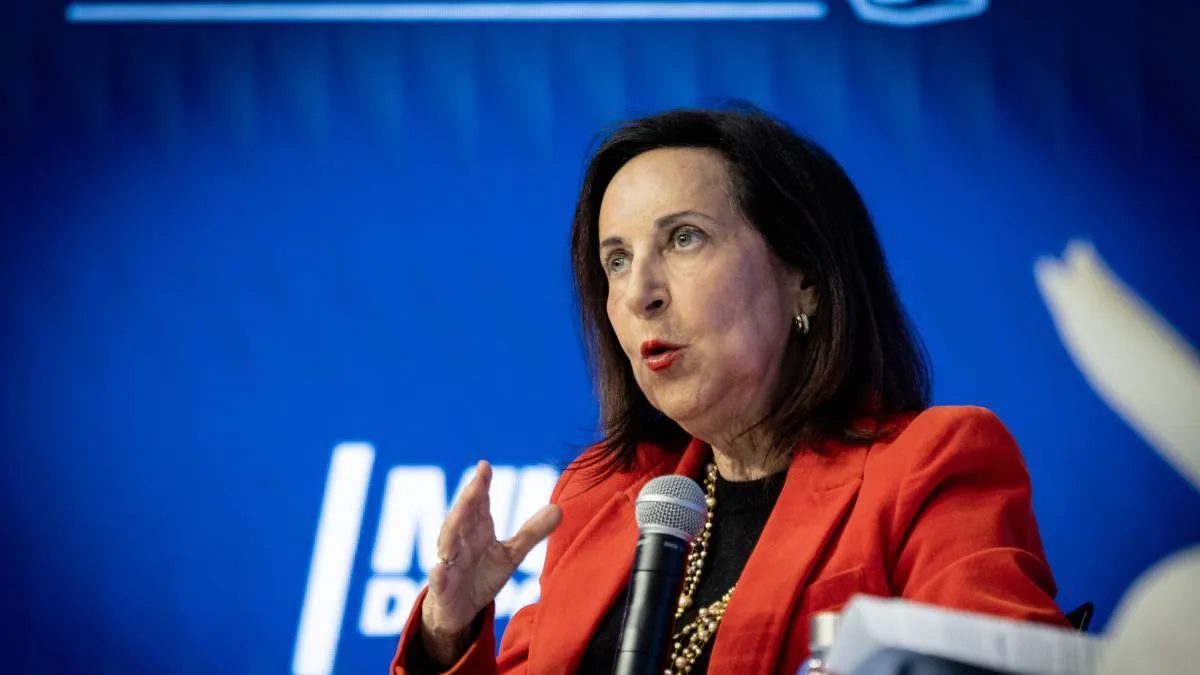
In a turbulent international context, dominated by armed conflicts and the rise of the far right, the Minister of Defense, Margarita Robles, positioned Spain this Tuesday as a hub of security and commitment to peace and a multilateralism based on solid rules, thanks to the political stance of the Government to which she belongs. Robles claimed this Spanish position, opposed to the two fundamental wars currently affecting Europe and therefore Spain, those of Ukraine and Iran, for being contrary to international legal order. “Spain says no to illegal offensive wars that have no international umbrella.”
Read more A Valencian oceanographer travels aboard the cruise ship experiencing a hantavirus outbreak
In a new edition of the Vanguardia Forums, Robles outlined the defense policy that Spain maintains, fully “defensive,” which is precisely NATO’s leitmotif, she recalled. “We are committed to peace,” emphasized the minister, for whom the wars in Ukraine and Iran are two clear examples of attacks, the first by Vladimir Putin, and the second by Donald Trump, despite the fact that “it has no internal support even within the U.S.” and started without a clear objective,” she stressed.
That is why Robles justified Spain’s involvement in the Atlantic Alliance, which makes it a “serious, responsible, and reliable ally,” and with the increase in military spending up to 2%, an investment that Europe, including Spain, must undertake “without complexes” to face new challenges, among which are the invasion of Ukraine, “very important for Europe,” and the reduction of military dependence on the U.S.
At the event, moderated by journalist and Director of Institutional Relations of the Godó Group, Ramon Rovira, along with Lola García, deputy director of La Vanguardia, and Mònica Hernàndez, deputy director of the program El món a RAC1, Robles reinforced Spain’s reliable role in light of the latest announcements from the Donald Trump Administration to reduce the troops it currently has in Germany. That reduction of 5,000 soldiers does not worry the minister, who placed this decision within a U.S. approach already known based on “focusing on the Indo-Pacific.” “Trump wanted to present it as a kind of sanction to Europe for not supporting him in Iran,”
But Robles did not want to consider the possibility that the U.S. would do the same with the troops it has at the Spanish bases of Rota and Morón, despite Trump’s latest outbursts suggesting that possibility. The Defense Minister limited herself to commenting that “we cannot act based on the decisions that a particular country might make” and that “Trump must know and I believe he does, the commitment Spain has” with the Atlantic Alliance. She also does not see a likely U.S. exit from NATO, its most significant member, among other things because it is a decision that “does not exclusively correspond to Trump,” but also to its representative chambers.
The wars in Ukraine and Iran monopolized much of the conversation, in which other conflicts surfaced, such as those in the Sahel and Mali, where the threat of jihadist fundamentalism proliferates with the consequences that this may have for southern Europe, and therefore for Spain. Even so, the threat that Russia represents for the eastern flank of Europe received special attention because of what it means for the EU. “We cannot forget Ukraine. It is fundamental. Putin’s power is a threat not only to Ukraine but to the entire EU,” assured Robles, for whom this conflict has become an “infinite tie.”
Read more What is known about the cruise affected by hantavirus
This graphic expression reflects four years of war, despite Putin “thinking he would win it in four weeks,” warned the minister. “We are in a situation of infinite tie because Ukraine will never surrender,” she insisted, while the Baltic countries, among which she mentioned Estonia, Latvia, Lithuania, and Moldova, “live the attacks and threats from Russia with fear.” That is why, for Robles, “defending Ukraine is defending our values, our citizenship, and above all shows that we are vulnerable.”
Only this conflict, in addition to the growing distrust in the Trump administration, makes it “so important to bet on greater strategic autonomy for Europe,” which “must strengthen its forces, its technology, its security and not act with complexes.” If “for a long time it was thought that Daddy USA looked after Europe,” now “Europe must be aware that the transatlantic link is very important, but it has to self-protect, because there is also war in cyberspace,” she pointed out.
This need is what has led Spain to increase its defense investment up to 2%, but not up to 5% as the U.S. demanded, something that would have meant cuts in the Welfare State, according to the Government. Robles boasted about this increase in spending: “When we came to Government we invested 8 billion, now 33 billion. Investing in defense is investing in peace, in security, in jobs. There is no need to have any complexes…. and I say this from the point of view of a progressive government,” she warned.
In this area, Catalonia has a long way to go. In fact, it is one of the autonomous communities whose industry in this segment has less weight in relation to GDP, but the Government of Salvador Illa has set out to reverse this trend. Robles acknowledged this interest from the Catalan Executive and highlighted its potential, recalling that in defense matters quantity is not as important as quality. “The important thing is to spend better” and “most of the investment we make is dual,” so that its purpose is not to increase the capabilities of the armies, but also technology.
Read more Argentina records 41 cases of hantavirus in 2026 and an increase compared to recent years