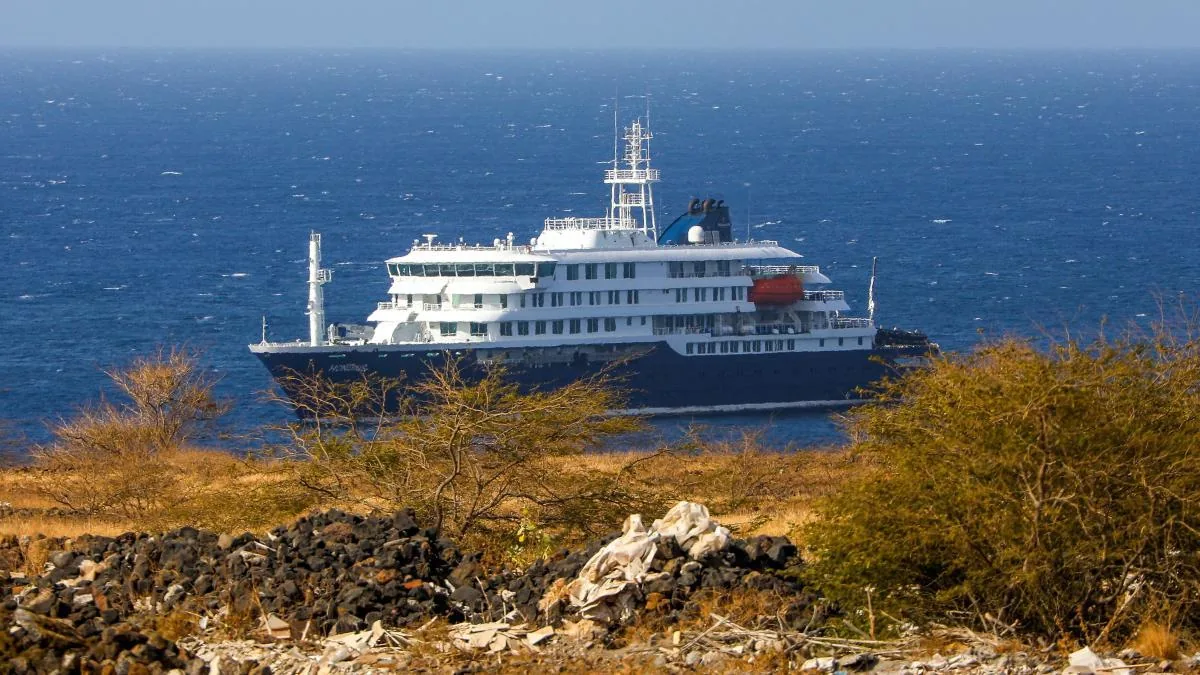
When it was launched in Croatia, neither the builder nor the owner of the Hondius imagined that its name would become known worldwide for something so undesirable. The idea, when the keel was laid, was for the ship to stand out for having a reinforced hull capable of breaking ice up to eighty centimeters thick. That has nothing to do with regular cruises.
Read more Alexia Putellas, tears with a taste of farewell
The Hondius is a unique expedition vessel, as are its passengers: they do not consider themselves cruisers, but maritime travelers seeking destinations where few arrive, just like the itineraries they undertake. The illness transmitted on board has also been unique.
The shipyard that conceived it, Brodosplit in Split, Croatia, has history. Founded in the times of the former Yugoslavia, when Josip Broz, Tito, still ruled from Belgrade, its facilities built devices that did not appear in tourist brochures.
Its official name then was Brodogradilište specijalnih objekata, which in Spanish would be “shipyard of special objects.” What they manufactured was indeed special: submarines for the Navy of the Socialist Federal Republic of Yugoslavia.
Decades later, from those same slipways, the Hondius was launched in 2019: a polar expedition vessel under the Dutch flag, operated by Oceanwide Expeditions, which has three more ships in its fleet: the veterans Ortelius and Plancius, as well as the schooner Rembrandt van Rijn.
The unwanted protagonist is a young and well-regarded ship. It is registered with polar class LR-PC6, a distinction granted by Lloyd’s Register for navigation in icy waters. A vessel designed to go where others do not. That is precisely where the problem lies, and also the greatness of this type of journey.
A journey not for everyone. Neither in price nor in character
The Hondius has nothing to do with Mediterranean tourism with daily port calls. Its passengers, a maximum of 170 at full capacity, are nature photographers, amateur biologists, or mature adventurers with high purchasing power and lovers of penguins and polar bears. They are attended by 71 crew members, including 13 specialized guides and the ship’s doctor. Most of those who board are between 45 and 65 years old. After having traveled more than half the world, they want to reach the edges of the planet.
The price matches that exclusivity. The shortest itineraries aboard the Hondius start from about 9,650 dollars per person (around 8,250 euros), although the longer trips, those including the Falklands, South Georgia, or Antarctica, can exceed 24,600 dollars per person, about 21,000 euros.
Pure expedition luxury
Travelers in single suites pay a supplement of 1.7 times the base price, which can bring the bill to figures that no longer admit comparison with other types of tourism. It is not a mass product: it is pure expedition luxury and, in the case of a trip of almost two months, even more so.
Read more How Mbappé became the star of detachment: «He was given a very big ego»
The itinerary that went from discretion to worldwide news had two phases. The first was a round trip from Ushuaia to the Antarctic Peninsula, between March 10 and 31. On April 1, the ship departed again northward, visiting the South Georgia Islands, Tristan da Cunha, and Saint Helena, that isolated Atlantic corner where Napoleon spent his last five years, before heading to Cape Verde. Almost two months at sea. For some passengers, the trip of a lifetime. For others, it is becoming a nightmare that has not yet ended.
Protocols at sea: when the ship’s doctor is not enough
Every expedition vessel carries a doctor on board. Its capabilities, however, like those of any floating health facility, have obvious limits. When cases worsen, the solution is evacuation. In the South Atlantic waters, that means helicopter or diverting the ship to the nearest port, which can be days away by sea.
Protocols in the event of an outbreak on board are strict, although passengers usually are unaware of them until they are activated: isolation of the affected, internal quarantines, reinforcement of hygiene measures, and coordination with the health authorities of the coastal countries.
The authorities of Cape Verde visited the ship, evaluated the two symptomatic crew members, and refused to allow disembarkation as a precautionary measure.
Is there a morgue on a ship like the ‘Hondius’?
It is the question no one asks when boarding, although it has an answer: all large ships are required to have doctors and health facilities capable of certifying a death. Once confirmed, the crew transfers the body, with the greatest possible discretion, to the ship’s morgue. These facilities usually have capacity for between three and six bodies kept between two and four degrees Celsius. The remains can be preserved on board for several days.
In the case of the Hondius, a ship that operates for weeks in extraordinarily remote areas, that capacity is not only recommended but essential. This episode demonstrates it harshly. The first deceased died on board on April 11 and his body was not disembarked until the stopover in Saint Helena on April 24. Thirteen days at sea. As these lines are written, the body of the third deceased passenger remains on board, anchored off the African coast, waiting.
Maritime laws do not explicitly require having a morgue, although the International Maritime Organization recommends that ships be prepared for it. In polar expeditions, that recommendation ceases to be bureaucratic and becomes an operational necessity.
The future: more ships, more risks
The case of the Hondius is not just the chronicle of an outbreak. It is also a warning about what may come. Expedition navigation to the poles has grown steadily over the last decade. Each austral season, more ships (many operated by small specialized shipping companies) depart from Ushuaia, Puerto Williams, or Longyearbyen to regions where there is no hospital, airport, or any kind of health infrastructure.
Read more The abyss loses its witnesses