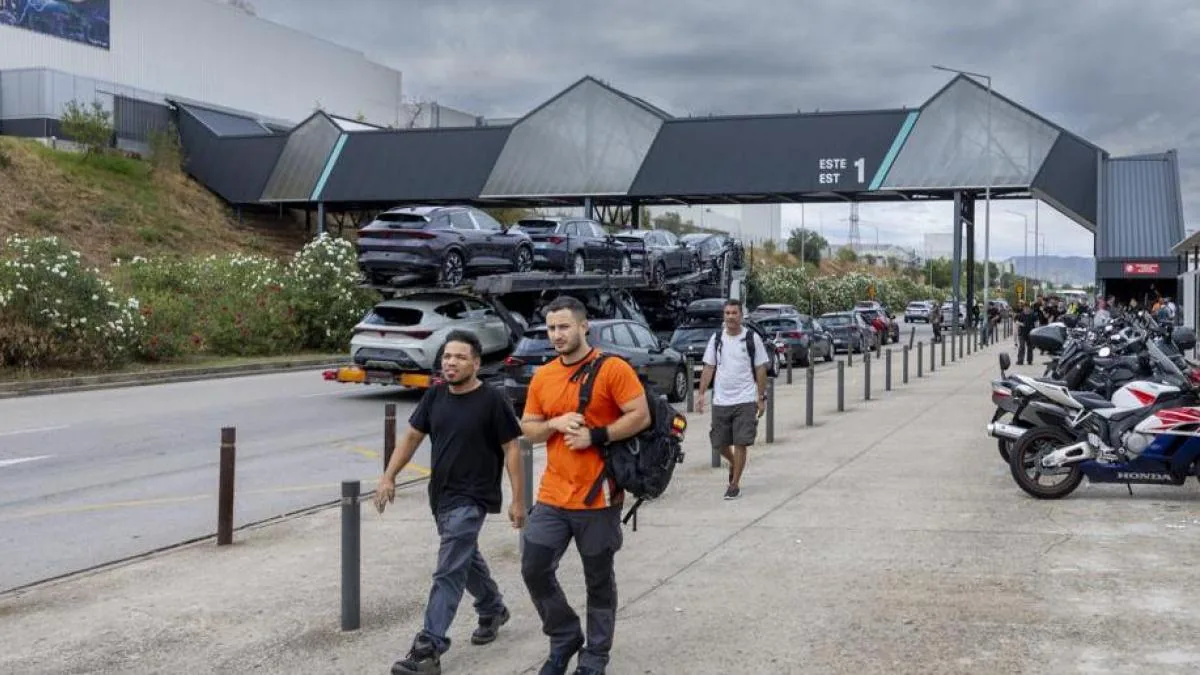
The survival of the Seat brand beyond 2030 “is still being analyzed,” with “various scenarios” and “all options” on the table, ranging from continuity to its disappearance, it was warned in a company statement distributed yesterday. Without having made any decision yet, “the continuity of the brand will be evaluated based on how regulations – such as emissions – evolve, customer demand, and market conditions.” These are three key factors that will define its future. The statement included words from Oliver Blume, CEO of the Volkswagen Group, its owner, in which he showed strong support for Seat S.A. – the parent company and responsible for the Martorell plant – but without direct reference to the Seat brand.
Read more The Apple empire enters the Ternus era
This officially confirmed that the brand is under review, after internal Volkswagen documents were leaked on Thursday suggesting its elimination and integration into Cupra by 2029 at the latest, as part of the group’s major restructuring. Seat has not received a new model for years and has not joined the electrification wave. Its roadmap only includes the launch of hybrid versions in 2027 of the Ibiza and Arona or updates. “Beyond the current product cycle, the future of the Seat brand is still being analyzed,” it was explained.
The environment may work against it. There is talk of a more demanding and competitive context, especially in the last year, which “makes the analysis to continue investing in the Seat brand increasingly complex.” For example, with tougher emissions regulations and penalties that have a growing impact. Regulation is important because the current European framework limits combustion cars by 2035, a technology that supports its sales since it does not have and is not currently planned to have electric vehicles. The “cost of electrification” and “the necessary investment” to deploy a new range also impact here. All this forces a “constant reevaluation” of strategy, investments, and business models.
Blume does not show direct support for the Seat brand, but does for its parent company, which owns the factories, and for Cupra
Blume assured that “Seat S.A. – parent company of Seat and Cupra and responsible for the Martorell factory – has an important role to play in the future of the group,” following the assignment of the Cupra Raval and Volkswagen ID.Polo within the group’s electrification, in which the Seat brand has been left out. With the electrification of Martorell completed, he recognizes “the capacity for transformation,” with a “solid base” in the Catalan factory and “the unstoppable growth of Cupra.” “This gives me a lot of confidence for the future,” he added. “We are committed to continuing to build on this base and to create conditions for Seat S.A. and Cupra to continue growing,” Blume stated. But “at the same time, we must remain flexible and adapt our brand and product strategies to regulation, market conditions, and what our customers demand,” he warned.
Read more El Jazzsí, where Rosalía honed her live performance, sounds again
Blume spoke about the growth of Seat S.A., the parent company, and Cupra, without specifically mentioning the Seat brand. He emphasized that Seat S.A. “has a solid future,” guaranteeing the continuity of manufacturing, without defining under which brands. Seat sells less than Cupra but beats it in Spain. The electrification of Martorell “is a story of transformation, with Cupra as a key driver of our future growth and profitability,” said Markus Haupt, head of Seat and Cupra.
Also read
The unions remain alert to what may happen. The chairman of the works council, Matías Carnero, said the priority is “to ensure the future of the company and quality employment,” defending the two-brand scheme. Authorities showed their support for Seat’s future. The Minister of Industry, Jordi Hereu, repeated that it is a great brand for which he expects new industrial plans. The minister maintains contacts with its management and VW’s. From the Labor Department, they indicated that “Seat is not expected to disappear and jobs are not feared.” In Catalonia, the president of the Generalitat, Salvador Illa, said he will do “whatever it takes” to maintain employment and industry. The Minister of Enterprise, Miquel Sàmper, will closely follow “all decisions.”
Government and Generalitat closely monitor the continuity of the brand and associated employment
On the stock market front, Volkswagen achieved relief and soared 6.5%. Investors celebrate the cost-cutting plan – with details to be resolved – that focuses on reducing costs and increasing profitability. Bank Of America estimates that the departure of another 50,000 workers would save 2.5 billion annually by 2030. For Ferdi Dudenhöffer, director of the Center Automotive Research in Bochum (Germany), the plan “is positive” and will allow focusing on its core business, although “the battle for the future” is defined in China. In a similar tone, Kevin Thozet, from Carmignac, states that at a time of decline in the Chinese market, Volkswagen has excess capacity: “China has too many cars. Europe has too many factories. And both problems are colliding head-on.”