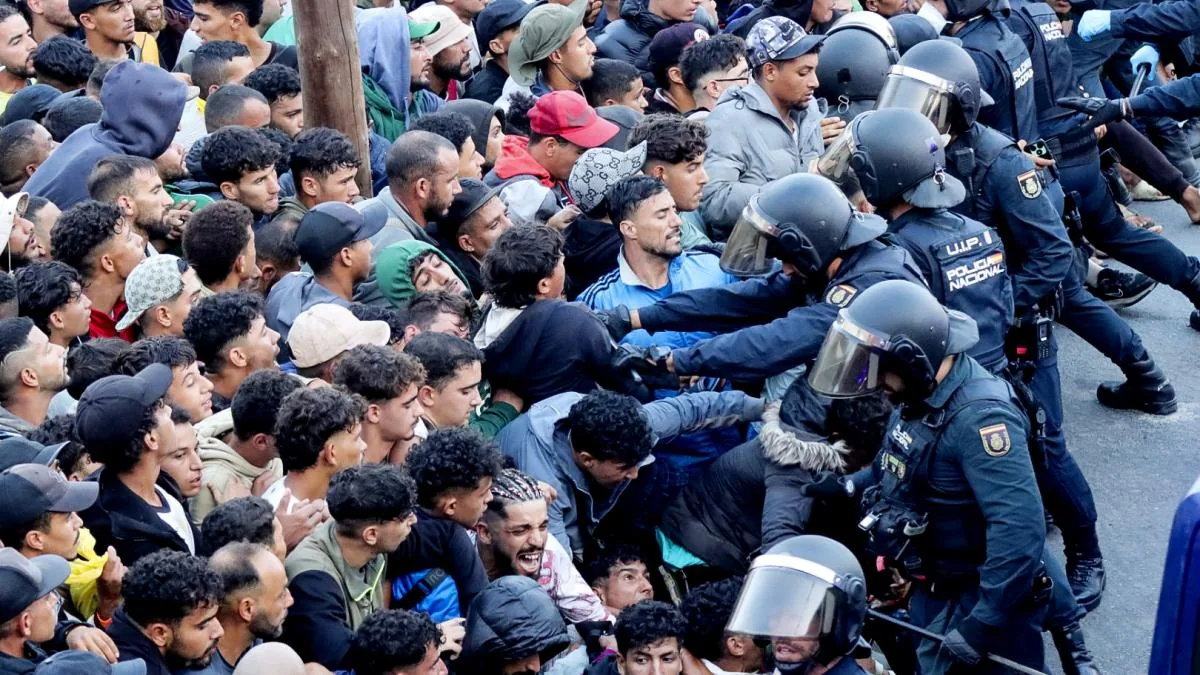
The Government held an almost monographic Council of Ministers meeting this Tuesday to mitigate the economic and social impact caused by the migration crisis unleashed at the end of July in Ceuta and approved this Tuesday an Urgent Measures Royal Decree-law that will mobilize 309 million euros in the remainder of 2026 — to which another 50 million in ICO guarantee lines are added —. This is an unprecedented injection equivalent to 16% of Ceuta’s Gross Domestic Product to be executed in just four months. The regulation not only seeks to immediately shield the productive fabric and social peace in the North African enclave, but also permanently extends part of its tax and labor advantages to Melilla in a clear exercise of preventive containment.
Read more The judges confirm that the ‘mountain’ of saline waste in Sallent must be dismantled
The decision formalizes the commitment advanced yesterday by the President of the Government, Pedro Sánchez, substantially raising the initial forecasts to address the gap opened in Ceuta’s economy, where preliminary business losses were already estimated at around 28 million euros. To contain the blow in the labor market and the finances of SMEs, the Executive has activated an economic relief package endowed with 80 million euros. Among the flagship measures are 36.6 million in direct aid to 2,600 self-employed workers (5,000 euros per self-employed worker) and 1,400 companies (with amounts ranging from 10,000 to 150,000 euros depending on turnover), managed through the Tax Agency from next September 14 to start being paid in October. Added to this are 14 million for consumption vouchers and tourism campaigns, extraordinary benefits for cessation of activity, and direct SEPE aid for training.
On the labor and tax front, the Royal Decree-law introduces profound permanent reforms for Ceuta and Melilla: the business discount on the Social Security quota for indefinite contracts rises from 50% to 75% — provided they are linked to training actions —, while the Corporate Tax increases its discount from 50% to 60% and the Personal Income Tax improves the taxation of the self-employed, which will mean a relief of 12 million euros in tax reductions. Temporarily, the Ministry of Labor articulates a force majeure ERTE regime with total exemption of quotas for companies with limited activity, as well as full access to unemployment for workers without consuming accumulated benefits.
Read more Germany evacuates more than 13,000 people to defuse a World War II bomb
The rest of the extraordinary budget addresses the logistical, security, and public services emergency that has overwhelmed local administrations. The largest item is allocated to humanitarian reception (118 million euros), of which 63.6 million will be specifically directed to the care of unaccompanied minors who remain in the city and 53.4 million to basic accommodation for migrants. In the field of security and defense, the State mobilizes 90 million euros, including 74 million for the deployment of the Ministry of Defense and the Armed Forces, as well as an exceptional performance incentive for the National Police (7.1 million) and the Civil Guard (8 million).
Finally, the plan allocates 21 million euros to strengthening essential services, financing the incorporation of 100 health professionals into INGESA, funds to speed up justice and free legal assistance, psychosocial support in educational centers, international promotion through ICEX, and direct subsidies to the autonomous city, among which stand out more than 7 million euros approved for the desalination plant. With this deployment, coordinated after the declaration of the situation of interest for national security and under the sole command of Ángel Víctor Torres, the Government seeks to close the emergency phase at the external border of the European Union and ensure reactivation before the expected visit of King Felipe VI to Ceuta.
Read more The new king of Norway, Haakon, will take the oath before the Norwegian Parliament