







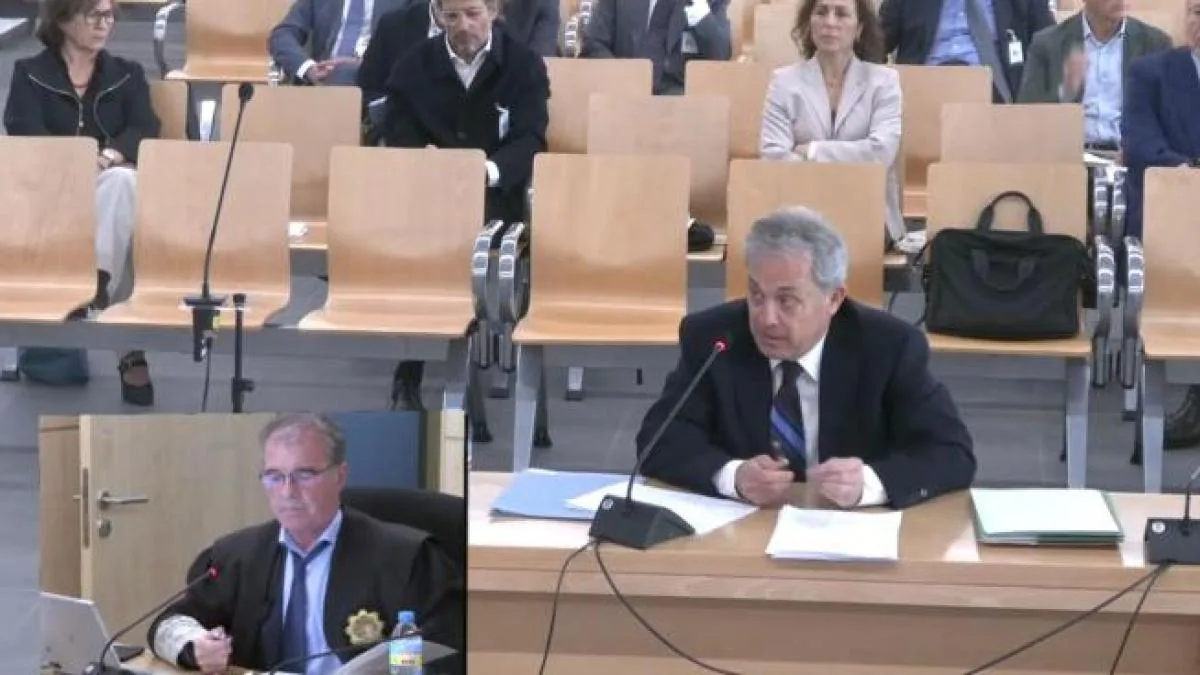
Jordi Pujol Ferrusola was the “driver” of the letters that his mother, Marta Ferrusola, sent to Andorra. The “missals”, in the terminology she invented to talk about money. This was explained by his son, during the two days of interrogation he underwent in the trial being held by the Audiencia Nacional against the Pujol family for alleged money laundering and illicit association.
Read more The superyacht of a Putin friend crosses the Strait of Hormuz
The main defendant in the case took the so-called “driver letters” to Andorra, “in a sealed envelope”, and handed them over to the bank manager Josep Maria Pallerola, he explained. The Pujols called him “priest”, as he himself admitted in his statement on March 11.
Answering questions from the prosecutor, Fernando Bermejo, Pujol Ferrusola explained that the document in the case file that refers to “missals” is in his mother’s handwriting, Marta Ferrusola, who passed away in 2024.
Pujol claims that in his years as an entrepreneur he made between 20,000 and 25,000 bank movements and cannot remember them all
In that document, “he asks Pallerola to move some money for him,” he detailed. “It’s a driver letter, someone brought a letter up from below,” referring to Spanish territory.
It was in that Andbank account where the family deposited the grandfather’s inheritance, according to the explanations he gave during the approximately seven hours that – until 12:53 this Tuesday – Pujol Ferrusola has been testifying in the trial.
The prosecutor asked about dozens of movements between, to, or from accounts belonging to Jordi Pujol Ferrusola, his six siblings, and his mother.
To explain why his accounts were so active, Pujol Ferrusola said that his way of operating was that “money is never still, not like many people did – maybe it’s a bit bold to say many people, people keep it in a corner, I don’t, I move it”.
Pujol maintains that in his years as an entrepreneur he made between 20,000 and 25,000 bank movements, across many different accounts, and that it is impossible for him to remember details of all those requested by the public prosecutor.
Pujol Ferrusola explained how and why they changed banks in Andorra.
In 2009, and especially after a G-20 meeting in London following the great global financial crisis, Andorra changed its legislation to adapt to the global fight against opaque money.
In that context, Andbank asked them to leave the entity “under the pretext that we are PEPs”, that is, Politically Exposed Persons. “They kicked us out,” he said. “I think they took advantage of the change [in legislation] to get rid of the dead weight, We are eight dead weights,” he detailed.
If they were “dead weight,” he argued, it was because the money they had there was “fiscally opaque,” he admitted when questioned by the prosecutor. And if it had that condition, it was because it came from the grandfather’s ‘inheritance’, invested in numerous “financial instruments,” he repeated about fifteen times. This inheritance consisted of 110 million pesetas in dollars and another 300 in various securities.
The Pujols, in any case, were not satisfied “with Andbank’s management,” “they had made many mistakes,” he added, so they sought refuge at Banca Privada d’Andorra. Upon leaving Andbank, they requested their documentation, but this entity had partially destroyed it.
Andbank invited the Pujols to leave the entity when it declared them Politically Exposed Persons, and in 2010 they ended up at Banca Privada d’Andorra
For this reason, the main defendant in the case filed a complaint in 2015 against Manuel Cerqueda, non-executive chairman of the entity; he said on March 10 that it was the other way around: that it was the Pujols who asked them to destroy all the documentation.
The family, in any case, moved their funds to Banca Privada d’Andorra (BPA), which is where it would be discovered in 2014 that they had money, and which is the trigger for this case. At this bank, he explained, they had the opportunity to create structures in Panama where they could place their investments.
One of the destroyed documents, according to Pujol Ferrusola, is a letter that would prove his father never held an account in Andorra.
“He never had it,” assures the eldest son. He outlined a bizarre operation to hide 307 million pesetas from his wife, though without wanting to harm her because “she is the mother of my children”.
In 2001, he wanted to prevent her from keeping half of that amount upon divorce – according to the verbal agreement to always split their businesses 50/50, which they had always operated under.
Although the divorce would not be formalized until 2014, already in 2001 Pujol Ferrusola had his father, who was still president, write a handwritten letter as if he were the owner of that money, deposited in Andbank. “I pressured him a lot,” he assured.
The letter stated that, if he died, everything should go to his wife, Marta Ferrusola. In parallel, and using the bank’s letterhead, the eldest son prepared another stating that the money belonged to his father, to remove it from the marital circuit. There would have been a third letter, held by Andbank, which would have been destroyed along with the Pujols’ documentation, according to the theory presented today.
Pujol Ferrusola personally guaranteed a loan through Banca Reig so that the 1999 CDC campaign, his father’s last, would be “acceptable”
Jordi Pujol Ferrusola explained that he himself guaranteed three loans to three companies – Hispack, Winner, and Altraforma – that participated in the 1999 election campaign. “Carles Torrent, treasurer of Convergència, came to see me and raised the issue of financing the election campaign. It was my father’s last campaign, and he asked if I could help them find financing, if I could find a loan. I told him not to worry, that I would help my father have an acceptable budget for the campaign,” he detailed.
He went to talk to BBVA, his main bank, but they denied him the loan because “there was a ceiling” if the fund was linked to political party activities.
That’s why he ended up at Fibanc, where Oriol Ribas, son of the former head of government of Andorra and executive vice-president of Reig Patrimonia, was a director.
“I gave them the guarantee from behind so that Banca Reig could grant it, until these companies amortize these loans and release my guarantee,” he detailed. “I just gave the guarantee and prayed,” he added, very graphically.
As he said on Monday, his second cousin Joaquim Pujol i Figa was in charge of managing the grandfather’s inheritance. When he was promoted to Secretary General of Industry, and then of the Presidency, Pujol i Figa entrusted him, who was then 32 years old, with taking responsibility for that problem.
The main defendant in the case denies ever having collected a commission from Grand Tibidabo, as the prosecution claims, nor from any Generalitat body
He did so for ten years, until in 2000 he distributed the corresponding share to each sibling, and each of them managed it as they saw fit.
The declarant denied ever having received money from the Generalitat. He vehemently denied that, as maintained by the Economic and Fiscal Crime Unit (UDEF), in 1991 he received a commission of eight million pesetas in commissions for a real estate operation by Javier de la Rosa’s company Grand Tibidabo. “Never,” not even his own companies or his clients, had income in Andorra.
Pujol Ferrusola refused to answer questions from the state attorney’s office. Upon announcing it, his representative, José Ignacio Ocio, dropped his stack of questions: hours of preparation work for nothing. The gesture caused hilarity in the courtroom. During the subsequent break, the accused chatted amicably with Ocio and his colleague, Álvaro Bazal, apologizing for not answering them.
Jordi Pujol Ferrusola’s ex-wife denies any real role in his companies. “I didn’t even have a key”
Jordi Pujol Ferrusola’s ex-wife, Mercè Gironès, has distanced herself from all responsibility in her husband’s companies, in which she held positions but had no real activity.
“I didn’t even have a key” to the office, on Ganduxer street. She described a tumultuous relationship in the final years of the marriage, during which he left and returned, until the definitive divorce in 2014. The prosecution is seeking 17 years in prison for her for the alleged crimes of illicit association, money laundering, forgery of a commercial document, and against the public treasury.