






Good morning,
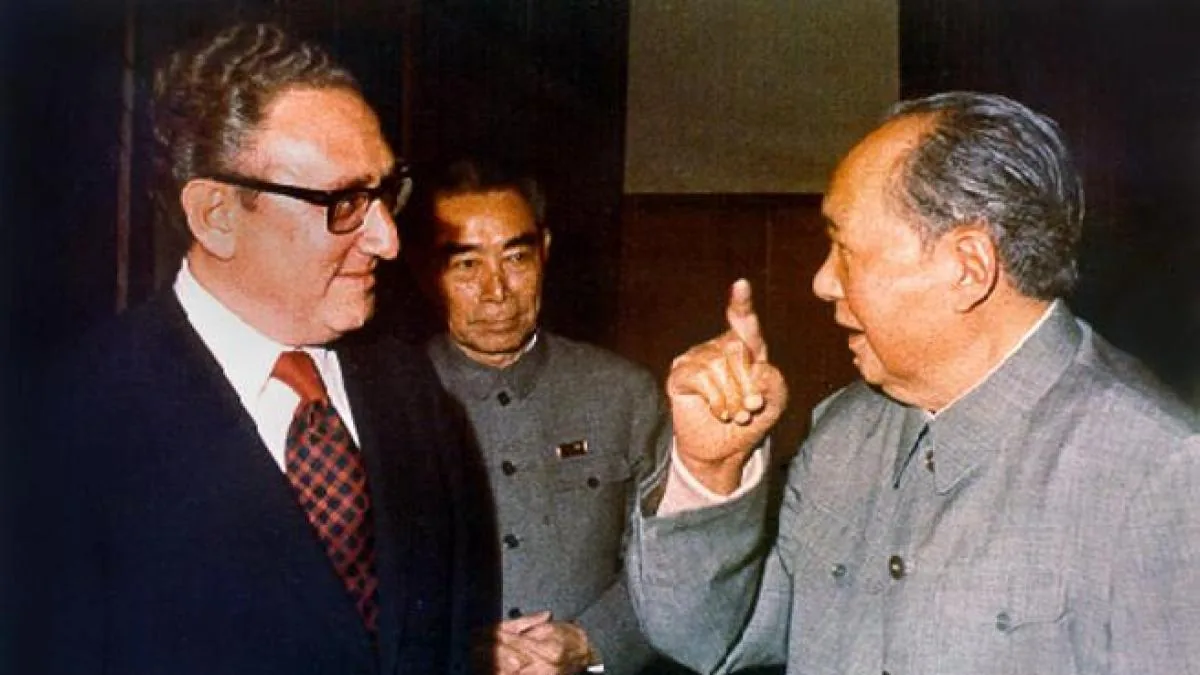
In July 1971, the then White House National Security Advisor, Henry Kissinger, was on a tour of various Asian countries. In Islamabad, during an official visit with Pakistani President Yahya Khan, he appeared unwell and exhausted by the diplomatic effort, and his host invited him to stay in a residential area in the mountains at an altitude of about 2,400 meters to recover. To everyone’s surprise, Kissinger disappeared for two days in the paradisiacal retreat prepared for him by the Pakistani authorities. From there, he would fly to Paris when he felt better, and the illness would remain an anecdote.
Much later it would be known that this indisposition was faked and had a code name: Operation Marco Polo. Kissinger did not go to the idyllic paradise that had been prepared for him; instead, another American diplomat went in his place. The astute American politician went to Beijing to hold a secret interview with Prime Minister Zhou Enlai to prepare for the historic trip that President Richard Nixon would make months later in February 1972, when he met face-to-face with Mao Zedong. When Kissinger made his secret trip, the United States did not maintain diplomatic relations nor recognize the Chinese communist government.
Operation Marco Polo was a success thanks to the complicity and discretion of the Government of Pakistan. In Washington, many collaborators of Nixon and Kissinger had no idea that this visit, which would have great consequences for world geopolitics, was being prepared. Pakistan maintained close relations with China and earned the trust of the United States. There was hardly any other country, at that time, to play that mediating role.
55 years later, Pakistan has once again played another very important mediating role. Islamabad is the capital where the United States and Iran are trying to reach a very complicated agreement, but, at the same time, very necessary for all parties. Since the beginning of the conflict, Pakistani diplomacy has maintained open lines, away from media noise, with both parties to seek a solution to the conflict. With Iran, there is a long and stable historical relationship, and they share a long border. In contrast, with the United States, there have been more diplomatic ups and downs. For example, in 2004, there were several Pentagon attacks with drone flights that violated Pakistani airspace in search of Al Qaeda leader Osama Bin Laden. However, ties between the two countries have improved with Donald Trump’s arrival at the White House. The Republican leader has occasionally referred to Pakistan’s armed forces commander, Field Marshal Asim Munir, as his “favorite” official.
It’s a shame that Henry Kissinger is not leading these conversations. The former Secretary of State under Richard Nixon and Gerald Ford, who passed away in November 2023 after turning 100, moved like a fish in water through the labyrinths of world geopolitics. He was by no means a saint, but he could contribute much more to the negotiations with Iran than is expected from Steve Witkoff and Jared Kushner, Trump’s two envoys. Their main credentials are that the first is a friend of the president and the second is his son-in-law.
After the failure of Pakistan’s latest mediation attempt, tensions are high. Anything can happen. Trump has increased the number of soldiers he has sent to the Middle East, and the two blockades continue. Iran’s Revolutionary Guard has closed passage through the Strait of Hormuz, and US Navy warships have blockaded Iran’s ports. The only positive aspect is that Trump announced on Thursday an indefinite extension of the ceasefire. It seems there is more desire to negotiate than to wage war, but the balance is very unstable.
Pakistan’s international prestige has gained points for this international mediation, but its position is not very comfortable. It is the official mediator, but at the same time, it has a defense pact with Saudi Arabia, by which, if that country requests help, Pakistan should come to its defense. And the Arab country has been the target of continuous attacks by Iranian drones, some of which have seriously affected refineries and gas facilities. Especially dramatic for the Saudi economy was the bombing on April 7 and 8 with drones and even missiles on the industrial complex of Jubail. A pipeline, which is the main export route for the petrochemical industry, was also affected.
If the mediation fails and they return to the starting point of the war, Pakistan could be dragged into intervening in defense of Saudi Arabia. Hence Islamabad’s interest in reaching a serious and stable agreement as soon as possible. The complexity of its position is explained by the fact that, while its diplomats were negotiating with representatives from Iran and the United States in Islamabad, Pakistani troops were deploying in Saudi Arabia in case intervention was necessary in the future.
The complexities of the negotiation lie with both parties. On the US side, Trump wants to achieve a graceful exit from the conflict he himself provoked by accepting the military intervention proposed by Benjamin Netanyahu. And the demands he has put on the table are hardly acceptable to Iran. On the other side, the leadership of the Persian country is not at all clear. In theory, power is in the hands of Mojtaba Khamenei, supreme leader since the death of his father Ali Khamenei in the attacks by Israel and the United States. The new leader does not appear publicly, and this has led Trump himself to question whether he is alive or dead. “Many people say he is disfigured and lost a leg and was very badly injured,” the American president stated. His absence has unleashed all hypotheses, and it is unclear how much power the Iranian negotiator — Iran’s Foreign Minister, Abbas Araqchi — truly has, as he is the one who has traveled to Islamabad to deliver Iran’s responses to Trump’s proposals. As the American president himself says on his social network, “there is tremendous internal struggle and confusion within their ‘leadership.’ Nobody knows who is in charge, not even them.” This last message from Trump last Saturday indicates that his patience is running out: “Too much time wasted on travel, too much work! (…) Besides, we have everything to gain, they don’t! If they want to talk, they just have to call!”
In this context of instability, the assassination attempt suffered by the American president this weekend at the White House Correspondents’ Dinner raises more questions about the future. We will see if the third assassination attempt suffered by the Republican leader will have any influence on his decisions regarding Iran in the coming days. Trump has already shown that he is capable of anything. And around him, he doesn’t have a Kissinger, or anyone like him, to approach the Iranian issue with more calm.
Read more The Tarragona judge keeps the Montoro case, for now
AS ALWAYS, HERE ARE OTHER NEWS OF THE WEEK THAT I BELIEVE YOU CAN’T MISS
An article by Shlomo Ben Ami on the lessons learned from the Iran war.
Laura Aragó offers us in this visual narrative work how the ships are trapped in the Strait of Hormuz.
Miquel Roca warns about the consequences of Trump’s policies and issues a loud complaint: Enough!
The A Fondo team has revealed another new lawsuit against TikTok for its tolerance of sex and violence.
A brilliant discovery by our correspondent in Asia, Jordi Joan Baños, about a Spanish woman who introduced us to Chinese literature.
Two good articles to reflect on the threat that the world of Palantir poses to the society of the future, by Ramon Aymerich and Manel Pérez.
A year after the blackout, Pilar Blázquez explains how the investigation is progressing and the clearest certainty: the bill has soared by 13%.
Josep Corbella explains the details and importance of the new CaixaResearch Institute inaugurated this past Friday in Barcelona.
And finally, this past week we celebrated our traditional Sant Jordi festival at the Hotel Alma and, as every year, we gathered a series of authors for our cover photograph. Two of those chosen, Eduardo Mendoza and Regina Rodríguez Sirvent, were the most read.
Read more The UCO chiefs on Ábalos’s role in the corruption plot: “He does the biggest thing”
AND THESE ARE MY ARTICLES FROM LAST WEEK:
-Tuesday, April 21: How to end the war
-Wednesday, April 22: Israel and the politics of gestures
-Thursday, April 23: Everyone’s Diada
-Friday, April 24: How Vox plays with the PP
-Saturday, April 25: The icing on the cake
-Sunday, April 26: Vielen Dank, Herr Flick