“With humility and joy.” This is how the King received the Pope at the beginning of the words he pronounced in the Royal Palace, in which there was no lack of reference to Spain’s Catholic roots, to the social work of the Church which, he said, contrasts with “the pain caused by cases of abuse, which neither are nor can be representative of the immense ecclesial community.”
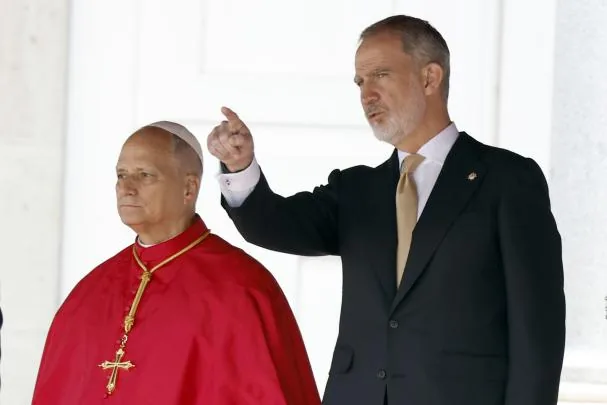
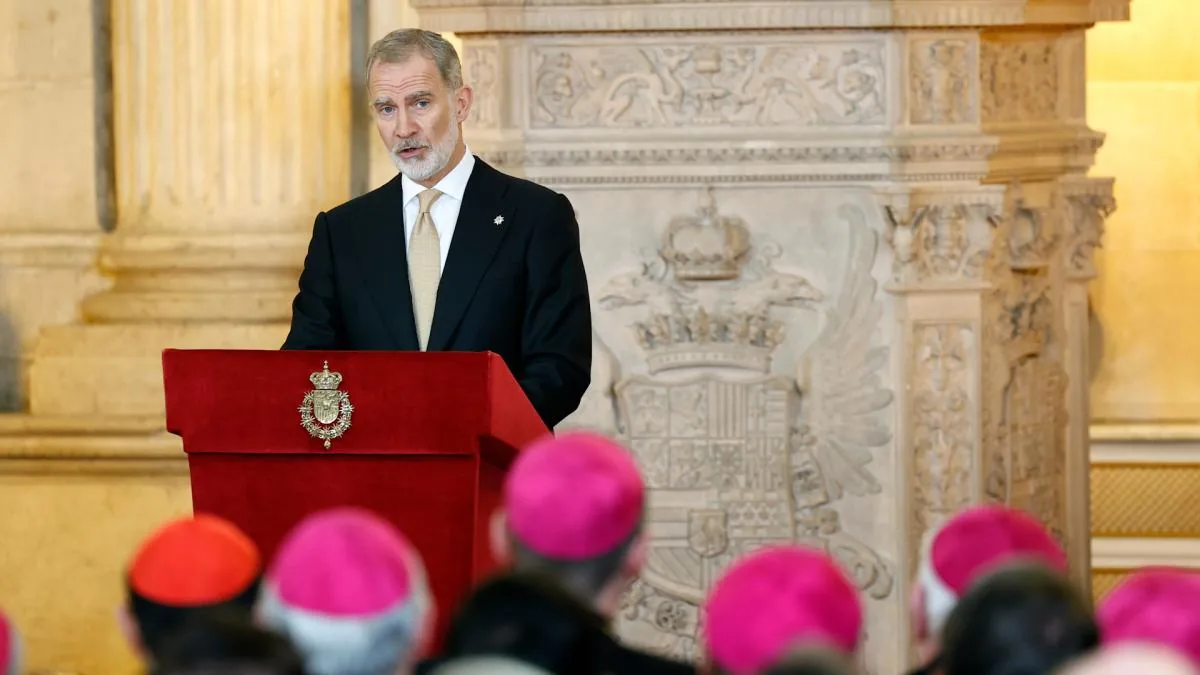
The King’s speech, which preceded the Pope in speaking, began with a welcome on behalf of the royal family, the Government and other State institutions, and all the Spanish people. “And I do so in a language that is also yours,” said the King, who recalled the Holy Father’s connection with Peru, which makes him especially close to all of Latin America.
“A people welcomes you,” said the King, “whom you know well: vital and with character, supportive and tolerant; also creative and cosmopolitan.” “The Catholic faith is rooted in our country and without it our history and our culture would not be understood.”
Felipe VI also highlighted “the enormous social work of the Catholic Church, the fruit of the commitment of religious men and women, priests, deacons, young people involved in parish life, volunteers who help in residences, shelters, soup kitchens and reception centers.”
It was at that point in the speech when the King referred to the most thorny issue, which he nevertheless addressed openly, by pointing out that, given the recognized values of the Church, “there can be no greater contrast than the pain caused by cases of abuse, which neither are nor can be representative of the immense ecclesial community.” He added that the “Pope’s clarity and firmness” on this issue “are essential in the healing and reparation process for the damage inflicted: they are for the victims, for the faithful, for the Church and for society as a whole.”
The King described the Pope as “a source of inspiration for more than 1.4 billion Catholics; but it resonates, due to its ethical content, much further: in all consciences,” with special mention of his first encyclical Magnifica Humanitas. “Your words,” said the King, “urge us to replace fear —which is sterile and paralyzing— with a thoughtful and shared understanding of the potential and risks of this new reality.”
Read more A Pope at the speaker’s rostrum of Congress
The King did not forget to reflect on “the risk of forgetting what truly matters, of sliding towards the mistaken belief that —with many of our references abolished by the pulse of current events— anything goes, everything is admissible, negotiable, and justifiable. And that is not the case. The dignity of the person, human rights, democratic values, and international legality must continue to be our prime numbers.” “Because in them,” added the King, “lies the arithmetic of freedom, equality, and justice; the one that adds and multiplies, not the one that subtracts and divides.”
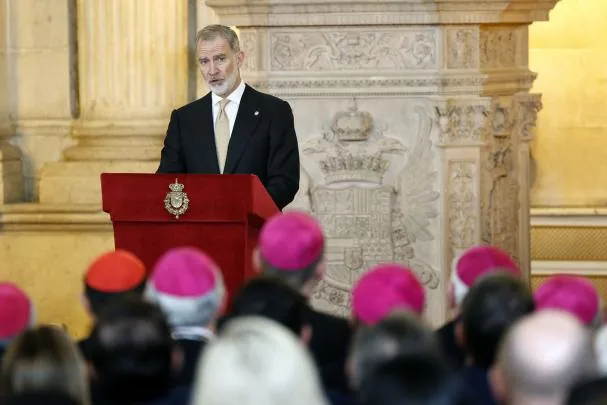
Felipe VI concluded his words by stating that “always, in word and deed —and especially in these times of uncertainty— it well deserves to be a universal standard of conduct: unity as a vehicle and instrument for peace.”
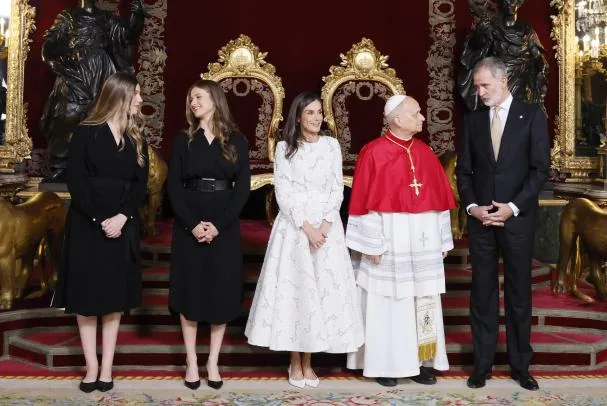
The Pope arrived at the Royal Palace’s Armory Courtyard in a car escorted by the Royal Escort Squadron on horseback. The Kings awaited him by the car and, subsequently, in the honor stand, he greeted Princess Leonor and Infanta Sofía. After the welcome ceremony, the Kings, accompanied by Princess Leonor and Infanta Sofía, held a meeting with the Pontiff in the Gasparini Hall and then proceeded to the Throne Room where the greeting to the authorities present took place, led by the Prime Minister, Pedro Sánchez, who had already greeted the Pope upon his arrival at the airport and after the welcome ceremony in the Armory Courtyard.
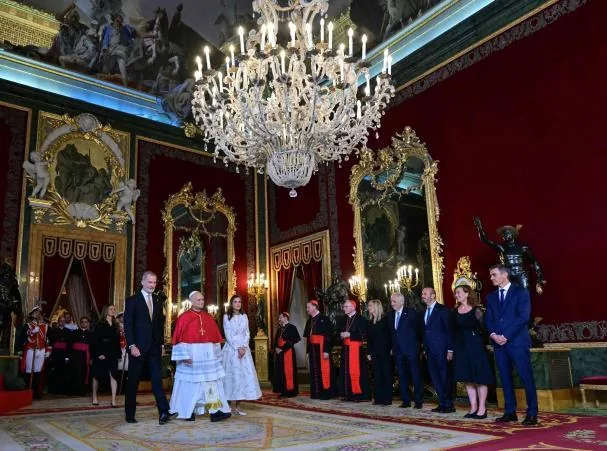
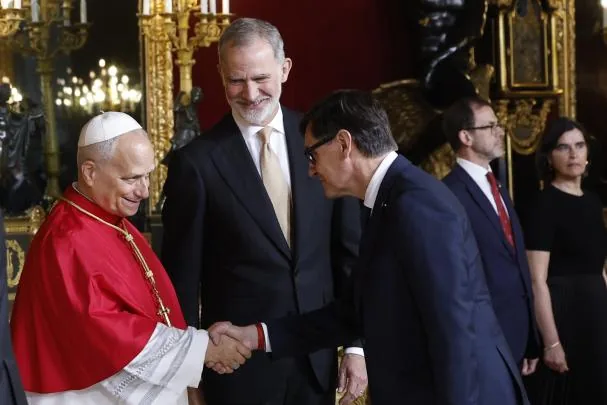
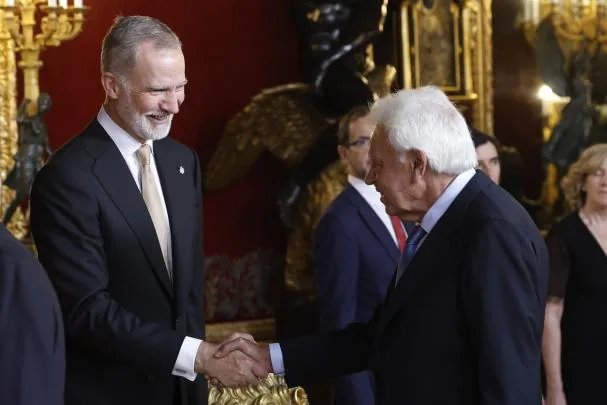
Around 250 people attended the official reception, where the Pope, the Kings, Princess Leonor, and Infanta Sofía gathered in the Throne Room. The Vice President of the Government, Yolanda Díaz, followed by part of the Government, was the first to greet, followed by the rest of the State authorities; the presidents of the Autonomous Communities, except the lendakari Imanol Padrales, led by the President of the Generalitat, Salvador Illa, the former Prime Ministers, Felipe González, José María Aznar, and Mariano Rajoy; the leader of the opposition and president of the PP, Alberto Núñez Feijoo, and the president of Vox, Santiago Abascal, as well as the president of the CEOE, Antonio Garamendi, and the general secretary of UCT, Pepe Álvarez. The Diplomatic Corps waited in the Hall of Columns where the speeches of the King and the Pope took place.
Read more The Pope begins his tour of a tense Spain, amidst high political tension