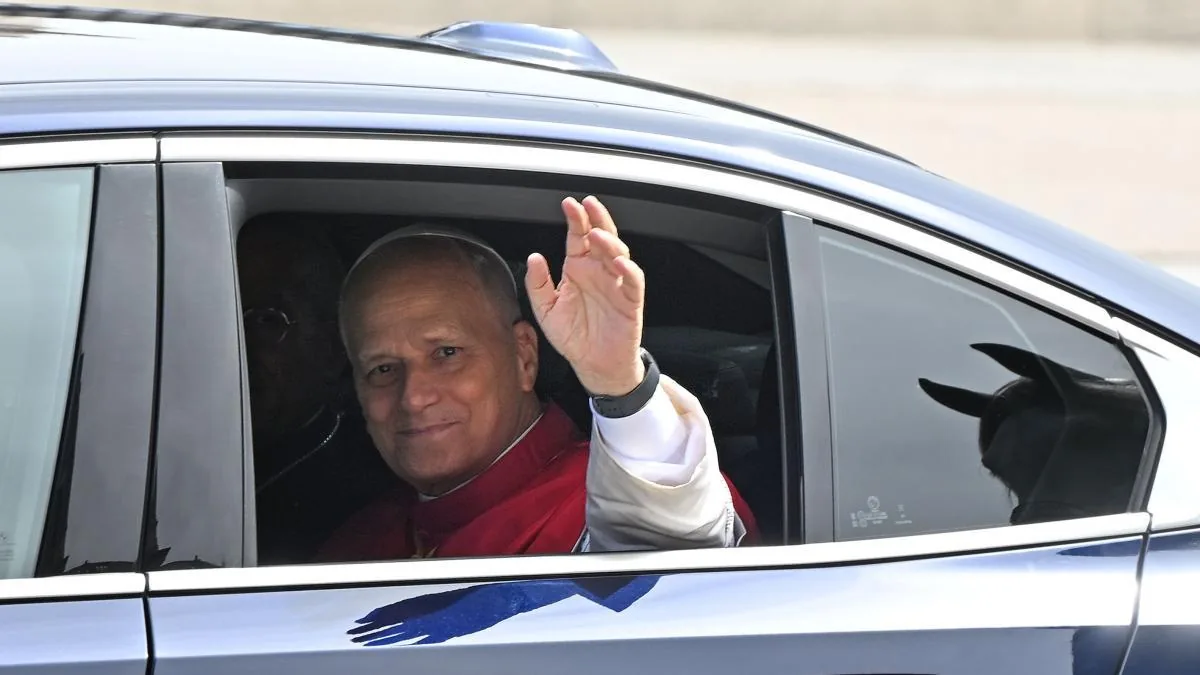
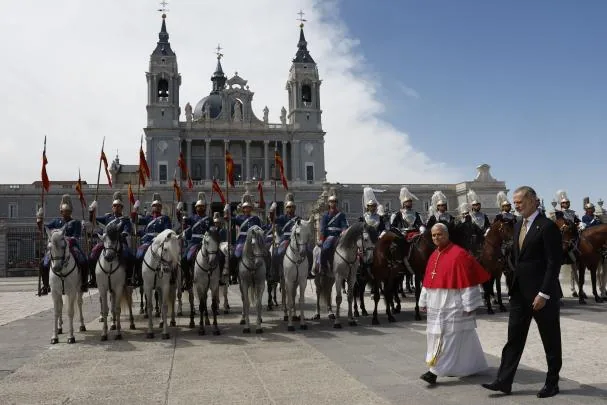
Evangelical message with political content and words of hope. Leo XIV has started his visit to Spain strongly with a speech in which he outlined the objectives of his apostolate: “I come to confirm, encourage and inspire a renewed fidelity of believers to the Gospel, as well as a deeper reconciliation and cooperation among the different forces of this nation.” Before the King and Queen, the Government, the powers of the State, social agents and the Diplomatic Corps, the Pope, who spoke in Spanish, recalled that the history of Spain suggests that “it is not the culture of confrontation, but that of encounter, which generates stability and prosperity.”
Read more A Pope at the speaker’s rostrum of Congress
The Pope’s words resonated in the Hall of Columns of the Royal Palace, the hall for grand occasions, from which he delivered his first message of the twenty-two he plans to pronounce until next Friday, June 12, when he closes his apostolic visit in Tenerife. A first message that concluded with an invitation to abandon “for the love of truth, divisive and polarizing narratives”
The Holy Father began by recalling the “ancient bond between the Christian faith and this land,” as well as the multiple expressions of popular faith that, along with the artistic and musical heritage, bear witness to the “fruitful encounter between Jesus Christ and your people,” to then proclaim: “It is a people full of passion, who love life and manifest it.”
He then began to unfold “a message of peace that in these times finds acceptance among those who do not enclose themselves in prefabricated ideologies, but open themselves to the truth.” He recalled the teachings of Pope Francis who warned of the risks of confronting ideas with reality, called for establishing a constant dialogue to prevent ideas from separating from the truth, and defended the need to protect “religious freedom and freedom of conscience.”
Read more The Pope begins his tour of a tense Spain, amidst high political tension
Leo XIV referred to two figures who, for five centuries, have nourished the life of the Church and the spiritual quest of many: Saint John of the Cross and Saint Teresa of Jesus. “Theirs is an open-eyed mysticism that helps us,” he said, “to bear the tensions that make our era so dark.” “That is why, also in public life,” the Holy Father continued, “men and women are needed who intuit, in the darkness, the light; in the end, a possible beginning.” He also referred to the figure of Saint Ignatius of Loyola, who understood that “the good he was attracted to was not utopian.”
In the Pope’s words, there was also a warning to avoid the temptation to gain popularity “by fanning the flames of polarizations that continue to grow” and cause “human dignity to be constantly violated.” However, the Pope saw hope in men and women who “faithful to the truth, advance, from stage to stage, to the point where conscience, justice, and peace embrace. In their freedom, we learn to be free.”
The Pope’s speech concluded by thanking Spain for its “fidelity to international law and multilateralism, which translates into an active commitment to peace and solidarity among peoples” and, at the same time, he reiterated the message of the need to “cultivate dialogue” and take into account “the perspectives of the poor and the young.”
Read more Florentino, struggling