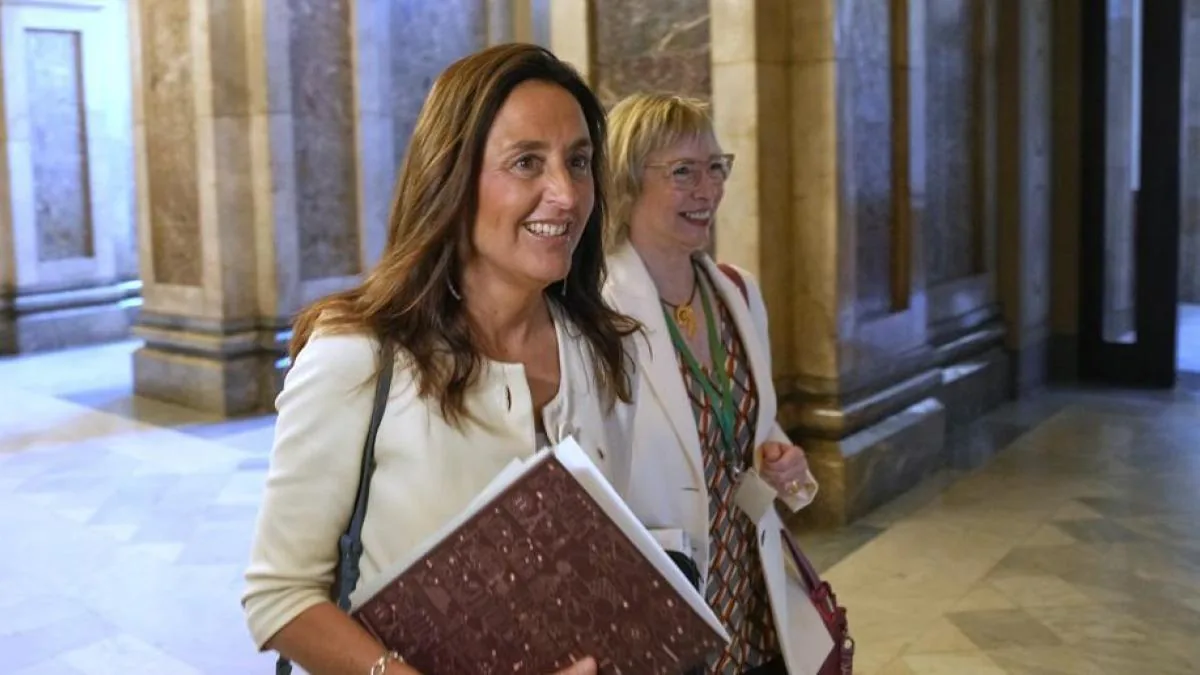
The Minister of Education, Esther Niubó, has expressed being “very happy and very satisfied” with the preliminary agreement reached last night between the Government and the unions to unblock the educational conflict in Catalonia. In an interview on ‘El Suplement’, from Catalunya Ràdio, Niubó described the pact as a “giant step” for the educational community, which had been “underfunded” during the last decades in Catalonia, she admitted.
Read more The six “objectives” of plumbing for the PSOE
The minister said that the preliminary agreement, which still has to be ratified by the teachers, required generosity from all parties and was very necessary: “Catalan teachers were at the bottom in Spain and in the next four years they will be among the best paid in the country,” she highlighted.
Catalonia was at the bottom in terms of pay and it is time to give back and compensate for this effort
Esther Niubó
Minister of Education
Niubó described the agreement as “very generous” on the part of all parties and emphasized that its value lies precisely in the shared effort. “Good agreements are those in which in the end no one is completely happy, but everyone wins. Everyone loses a little so that everyone can win,” she stated. The most moving message she received last night, she admitted with laughter, was from her mother: “She suffered a lot, the poor woman.”
Regarding the figures, the minister broke down the salary structure of the pact. The regional supplement, which was already increased with the March agreement with CCOO and UGT, will now rise to 170 euros per month, which added to the specific supplement will place the regional part of the salary at about 450 euros increase. With the state increases planned for civil servants, Catalan teachers will go on to earn between 600 and 630 euros more per month by 2029. “Catalonia was at the bottom in terms of pay and it is time to give back and compensate for this effort,” she emphasized, advancing that Catalan teachers will probably rank third or fourth in salary nationwide, only behind the island communities.
The minister firmly defended the March agreement, rejecting that it was a miscalculation by the Government to negotiate only with CCOO and UGT. “It was the best agreement that could be made at that time,” she argued, referring to the budgetary context then. “What we are doing now is expanding and strengthening that agreement.” Asked if the Government had underestimated the strength of USTEC, Niubó denied any slight: “We have been moving, taking steps forward. The Government has shown determination and responsibility.”
Read more It has been eight years now
Asked if the unions used the visit of Pope Leo XIV — scheduled for June 10 in Barcelona — as a pressure element, the minister flatly rejected the idea. “We are driven by convictions, not by mobilizations,” she stated, although she acknowledges that strikes “influence.” The more than 700 million additional that the preliminary agreement implies compared to the March agreement, she specifies, will be deployed over several years and have been coordinated with the Department of Economy.
Niubó, however, did not want to guarantee the end of all strikes. The CGT, which left the sectoral table before the agreement and has announced a campaign for the “no” in the consultation this weekend, remains outside the pact. “I cannot guarantee it because we have a union that was left out of this agreement,” she admits, although she trusts that the ratification of USTEC’s bases will allow the cancellation of all strikes called in Catalonia, including Monday’s.
The Government will address the problem of heat in classrooms
The minister also addressed the problem of heat in classrooms, acknowledging that more than 2,400 public centers in Catalonia are not climatically adapted. The Government has allocated 20 million euros urgently to install ceiling fans and has agreed with Esquerra Republicana a climate plan that will start with 100 centers equipped with aerothermal systems, with an investment forecast in educational infrastructures that will go from 50 million in 2014 to 400 million in 2030.
Read more The investiture partners distance themselves from the Government and put pressure on Sánchez