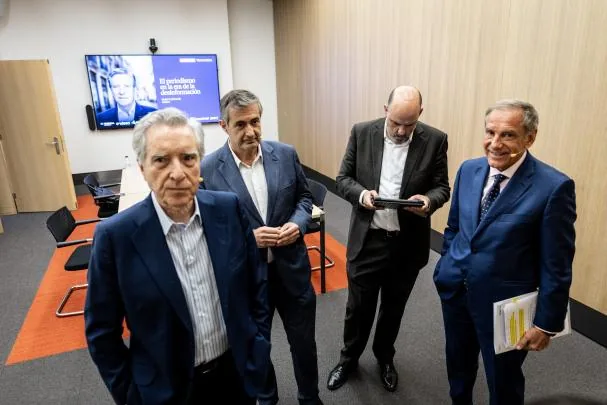
Journalism lesson from one of the great masters of the profession in Spain. Iñaki Gabilondo (San Sebastián, 1942), a deep connoisseur of Spanish politics, who lived from the front line of information the era of the Transition, was the guest this Tuesday at Foros de Vanguardia to talk about Journalism in the era of disinformation in the MGS auditorium, where he offered applauded reflections on the current political situation and the complex crossroads faced by the media
Read more More galleries than nightclubs
The news bomb of recent days, the investigation into former president José Luis Rodríguez Zapatero, was one of the issues addressed at the beginning of the talk, in which he was interviewed by the director of La Vanguardia, Jordi Juan; the journalist and editor of E l món a RAC1 , Jordi Basté; and the journalist and moderator Ramón Rovira.
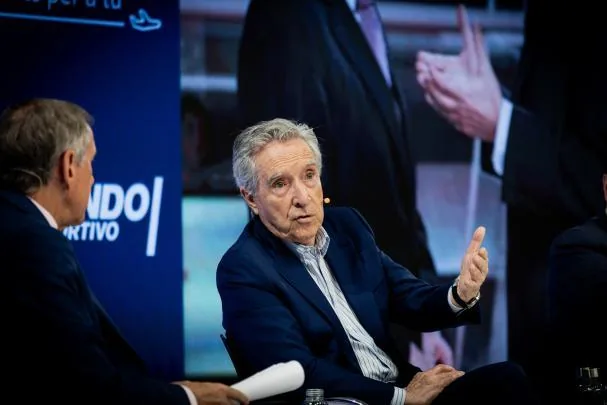
After recalling that, while “the Rule of Law tends to slowness due to guarantees, and the media tends to speed,” and asking journalists not to do “what some are doing, which is already taking the notes of the order as a sentence,” Gabilondo added: “it smells bad. There are clear indications that justify the judicial initiative.”
“Those of us who have known Zapatero and have dealt with him –he commented–, would wish that all this amounted to nothing. We would like that. But we fear there may be implications.” “I don’t know to what degree, but for now it doesn’t smell good. It even smells quite bad,” he insisted.
“The Zapatero case has scorched Sánchez, it has done him a lot of harm”
Asked if the Prime Minister, Pedro Sánchez, should call elections, Iñaki Gabilondo stated: “I have been surprised for quite some time that he hasn’t.” In his opinion, the Zapatero case “has scorched the president, it has done him a lot of harm. And also the socialism, because Zapatero was at the same time the great moral reference of socialism. He was the flag of decency of the Socialist Party, the flag of ethics.”
At one point in the talk he highlighted a specific aspect of this case. “The photos of a bunch of very big jewels are the entire iconography of gangsterism. This for the general public is a devastating image,” he pointed out.
Gabilondo considered it “tragic that half the country toasts with champagne because a corruption case has been discovered on the other side. It’s terrible.” “If there were a more general vision –he asked himself– wouldn’t it be normal for misfortunes to be received as misfortunes and for people to work together to try to end that scourge?”
Read more Renault reaches a wage agreement with the unions that secures five cars for Spain
The journalist lamented that “all the great reforms that have been talked about a thousand times are in the attic. We have the attic full of pending reforms. Why? Because they cannot be undertaken without agreement. And since there can be no agreement, to the attic.”
“The media live in financial panic and, looking for shortcuts, they resort to sensationalism”
Iñaki Gabilondo pointed out that worldwide “the media live in financial panic.” He indicated that the maximum radicalism experienced in the world of communication “is partly the child of ideology, and partly the child of financial despair.” He stated that “looking for shortcuts, you end up with frivolity, sensationalism, radicalizing so many things, forcing positions and disguising yourself as young.”
After recalling a maxim of disasters, that “in times of flooding, the first thing to run out is drinking water,” Iñaki Gabilondo made an analogy with “the informational flood, with a billion signals coming from all sides, true, false,” which makes it “difficult to find potable informational water.” In that respect, he considered that “ La Vanguardia is a great reservoir of potable informational water and to continue being so, it will surely have to invest much more money.”

Gabilondo reviewed some key moments of his career, such as the attempted coup of 23F, when he was directing TVE news, or the 11M attacks in Madrid, already at Cadena Ser, when, besides the horror for so many victims and the solidarity of the population, there was a moment when he realized that “the worst of 11M is that it disappeared devoured by 14M,” the elections three days later.
There was time to comment on the announced departure of Àngels Barceló from the program Hoy por hoy of Cadena Ser, which Gabilondo founded, attributing it to “an editorial disagreement” and, although he said he suspected who would end up replacing the Catalan journalist, he assured he had no direct information.
Read more Aznar asks citizens to defend democracy against right- and left-wing populisms