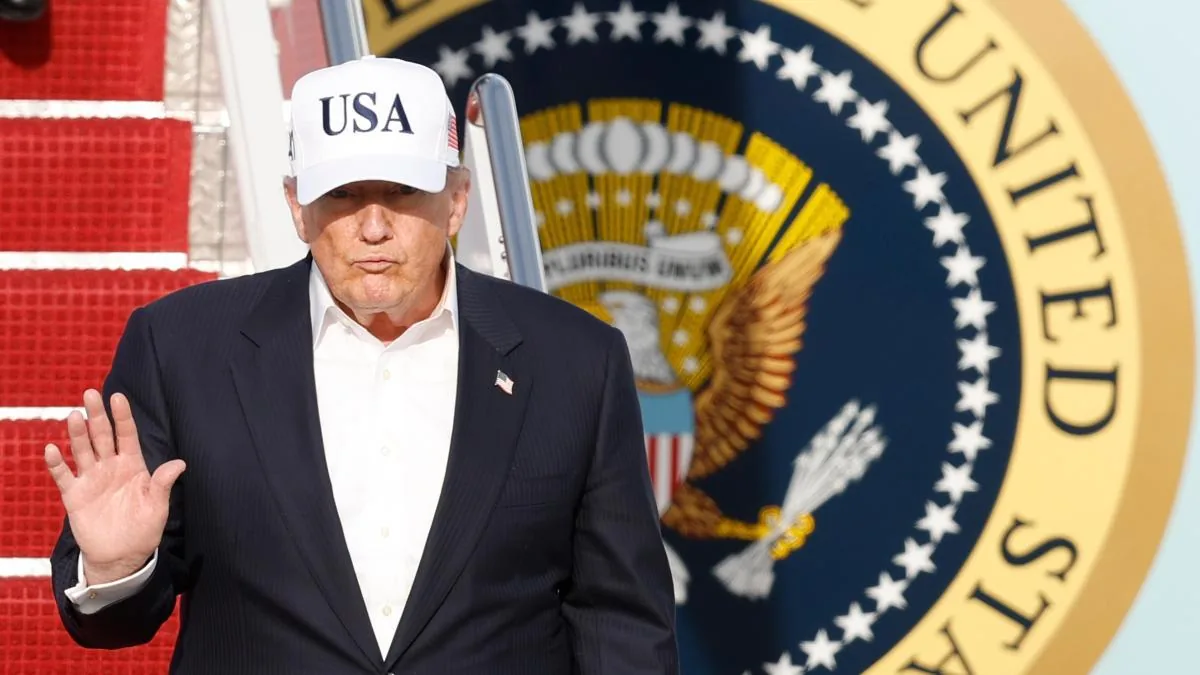
With the Iran war, the US president, Donald Trump, has made backtracking a habit. In the midst of efforts to reach an agreement with Tehran to end the conflict initiated by Washington and Tel Aviv at the end of February, the president uses backtracking as a pressure tool, although he risks calling his credibility into question. The latest example took the form of a message on Truth Social on Monday, where Trump claimed he had authorized a new wave of attacks against Iran starting this Tuesday, but postponed them after three leaders of the allied Gulf monarchies requested more time to negotiate the nuclear deal.
Read more The curious case of Donald Trump, getting younger and younger on his social network
In any case, Trump maintained a threatening tone and said he instructed his top military commanders to prepare for a “large-scale attack against Iran” if “an acceptable agreement is not reached.”
Saudi Arabia, Qatar, the United Arab Emirates and some others asked me if we could postpone it two or three days
Donald Trump
President of the U.S.
The US leader explained this at a press conference at the White House, after announcing it on his social network. “Saudi Arabia, Qatar, the United Arab Emirates and some others asked me if we could postpone it two or three days, a short period, because they believe they are very close to reaching an agreement,” he said. After discussing the matter with them, Trump said he decided to postpone the attack “for a time, hopefully maybe forever, but possibly only for a time.”
For weeks, Trump has publicly threatened to resume military attacks against Iran and has announced several ultimatums, increasingly frustrated with a war that, according to him, would end in six weeks but has already lasted more than two months. However, he has always retracted or extended the deadline.
Also read
Resuming the attacks would plunge the United States back into an unpopular and costly war. Instead, it has given Iran and the mediating countries more time to reach an agreement, even as negotiations over its nuclear program and the Strait of Hormuz have stalled, while a fragile ceasefire prevails.
Read more Vote again in Andalusia
Trump—who has always considered himself, above all, an effective negotiator—seems to have reached a deadlock with Iran, as his belligerent rhetoric and even military action have failed to make Tehran abandon its demands. US military officials say that in the months since the war began, the Iranian regime has shown enormous resilience and the ability to inflict significant damage on the region and the global economy by blocking the Strait of Hormuz, through which 20% of the world’s oil and liquefied natural gas passed before the war, and threatens to cause serious economic consequences.
In response to Trump’s message, Iran warned the US not to make a “miscalculation” again, stating that its Armed Forces have “their finger on the trigger” to respond “quickly, firmly, and powerfully” to any new aggression.
Negotiations with Tehran are stalled
Trump, who said he has informed Israel of his decision, explained that he will be satisfied if an agreement is reached that prevents the Islamic Republic from obtaining a nuclear weapon. Iran has repeatedly rejected the conditions imposed by the Trump Administration to curb uranium enrichment and on Monday announced that it has submitted a counterproposal through Pakistani mediators. “We don’t have much time left,” a Pakistani source told Reuters when asked if it would take time to bridge the differences, adding that both countries “keep changing the rules of the game,”
On Sunday, Trump threatened to resume the offensive, paused since April due to the ceasefire, saying that Iran is running out of time: “For Iran, the clock is ticking.”
Read more Alícia Romero appears to explain the details of the budget agreement