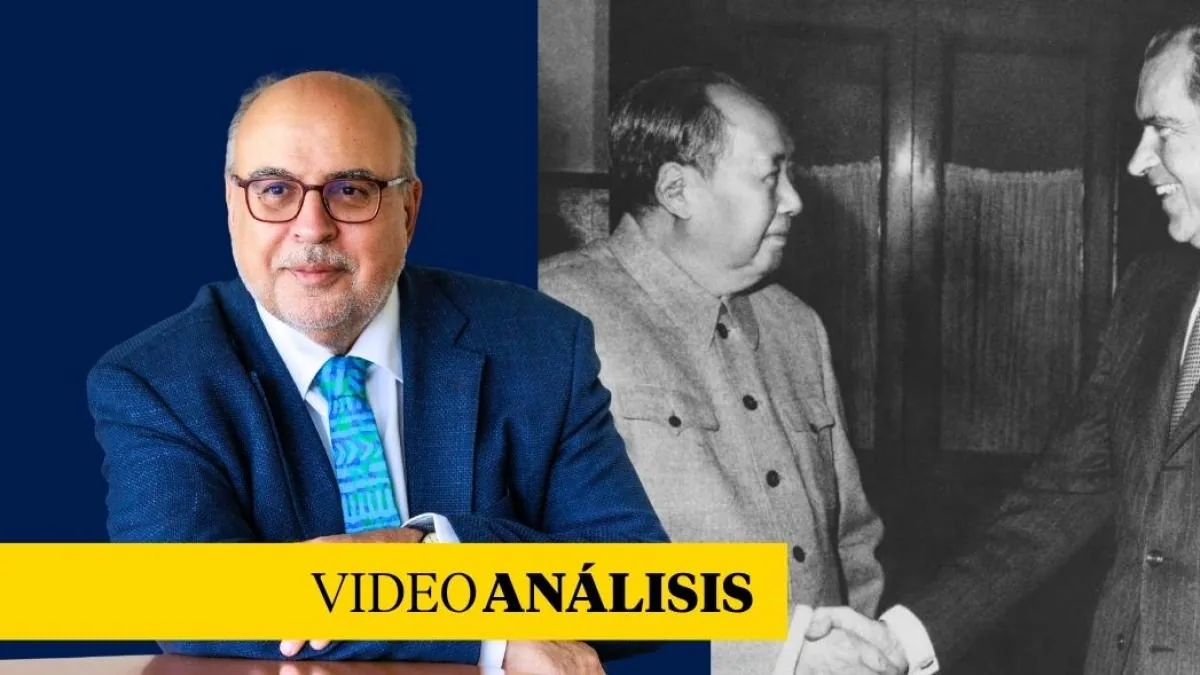
February 1972. First official trip of a President of the United States of America to the People’s Republic of China. Richard Nixon disembarks in a China still immersed in the turbulences of the so-called Cultural Revolution; an agrarian-based country with a very precarious industrial infrastructure, internationally isolated, at odds with the USSR since the death of Stalin in 1953. A collectivized country where almost everyone rides a bicycle. A poor economy that barely represents 9% of the volume of the United States.
Read more In Search of Winners at the Ópera XXI
The Americans are not at their best after the great consumer boom of the 60s. They feel pressured by the unfavorable evolution of the Vietnam War. Six months ago Washington abandoned the gold standard, breaking the international monetary system established at the end of World War II. Everyone talks about the Nixon shock. President Nixon broke with the system agreed upon at the international conference held in 1944 in Bretton Woods, a ski resort in New Hampshire. The dollar was directly backed by gold, at a rate of $35 an ounce. The United States faces a high fiscal and trade deficit aggravated by the Vietnam War. It needs to print money. It needs to postpone debts. And it wants China to stop supporting the North Vietnamese, who in turn have full support from the Soviet Union. Since Mao is at odds with the Kremlin, Henry Kissinger, Nixon’s Secretary of State, understands that it is possible to widen the gap between the Chinese and Soviets on the Eurasian continental platform. This is one of the objectives of the surprise trip to China in 1972. Let’s get to work.
Also read
May 2026. Last trip of a United States president to the People’s Republic of China. After Nixon, almost all American presidents have made official trips to China, with the exception of Jimmy Carter and Joe Biden. During his first term (2016-2020), Donald Trump traveled to Beijing, being received by Xi Jinping, who already emphasized on that occasion, March 2017, the imperial past of his country. Fifty-four years have passed since Nixon’s trip. Half a century later, China represents 64% of the economy of the United States and has become the great political, commercial, and technological competitor of the world’s leading power. Many Chinese still keep the bicycle, you never know what might happen tomorrow, but their preferred means of transport is now the electric car. At this moment, China leads the manufacturing of electric cars in the world and tries to match the United States in the development of so-called artificial intelligence.
The extraordinary speed of China’s economic development is the great theme of our time. It is an event unparalleled in human history. In 50 years they have learned to develop all the most advanced systems with the lure of the great factory of the world, where everything was cheaper to produce thanks to the low wages of an efficient, hardworking, and disciplined industrial army. Thanks to those first agreements with the United States, three million Chinese university students have completed their studies at American universities and most of them have returned to their country. Such a transfer of technology had never been seen before.
The extraordinary speed of China’s economic development is the great theme of our time
Nixon arrived in China observing Mao Zedong as an exotic being. Kissinger seemed to enjoy it. In all the photos, the Secretary of State appears smiling. The idea was his. Mao’s number two, Zhou Enlai, lean, with a penetrating gaze, carries the weight of the meetings, very aware of the step they have just taken. China definitively breaks ties with the Soviet Union and begins its own journey towards pragmatism. Soon the reformists will start to rise.
There is an opera about Nixon’s trip to China, with music by John Adams and libretto by Alice Goodman, a production staged in 2023 at the Teatro Real in Madrid. It is titled Nixon in China. In that opera, Zhou Enlai appears as the character who carries the story on his shoulders, surrounded by files and folders. Nixon is constantly concerned about what the American press says about his trip, he is impetuous and at the same time needs recognition. Kissinger is very smart, tries to please, and measures his steps well. Mao is a living legend who recites aphorisms, immersed in self-contemplation. Mao’s wife, the feared Jian Qing, organizes revolutionary ballets. Zhou governs the situation. Zhou Enlai, prime minister between 1949 and 1976, the year of his death, was always loyal to Mao, went through all phases, initially supported the leftism of the Cultural Revolution to not upset the Great Leader, then began to slow it down, and saved various leaders threatened by the Red Guards, including Deng Xiaoping, future reformist leader. Zhou Enlai, number two of the Chinese communist revolution, was descended from a family of ancient imperial officials; we could say he had the State in his head.
Also read
Perhaps one day an opera or a novel will be written about Trump’s recent trip to Beijing, surrounded by some of the main executives of the new American economy. There was the ousted Elon Musk. His presence in the presidential entourage meant a rehabilitation, after his break with Trump more than a year ago. Musk wants to sell electric cars in China. There were the CEO of Nvidia, Jensen Huang, and the CEO of Apple, Tim Cook. The CEO of Blackrock, Larry Fink, could not be missing. Also present was the top executive of Cargill, the main American multinational in the food sector, since the trip was expected to discuss agricultural and livestock matters, for example, the purchase of large batches of American soybeans. Good news for Midwest farmers, timely help for the Republican vote in the midterm elections in deep America.
Presenting the president’s trip to Beijing as a great commercial operation was a smart way to disguise the main strategic anxiety contained in the agenda: how to get out of the Ormuz quagmire without it seeming like a defeat.
Read more Yamal, Israel and everything depends
In 1972, Nixon was also moving in that orbit: how to find a way out of the Vietnam War without it seeming like a serious defeat. The Chinese leaders knew at that time what the Americans’ most immediate concern was. They supported the Vietnamese communists and at the same time were wary of the strong national independence sentiment of their leader, Ho Chi Min, whose main support ended up being the Soviet Union. The Vietnamese saw the hospitality to the American leaders in Beijing as a betrayal. China focused its attention on Cambodia, and in 1979 there was a brief period of war with Vietnam on the northern border. The Vietnamese ended the delirious regime of Pol Pot in Cambodia, and the Chinese interpreted it as an attempt to control all of Indochina, under the impulse of the USSR. Indeed, Kissinger had managed to widen the gap between the Chinese and Soviets.
Like Trump, Nixon was also looking for a way out: how to end the Vietnam War without it seeming like a serious defeat
Nixon seemed to enjoy that first trip to China. They had caught half the world by surprise. A year earlier, Kissinger had secretly traveled from Islamabad (Pakistan) to Beijing to negotiate with Zhou Enlai the scope of that first meeting, which seven years later would lead to the full restoration of diplomatic relations and a slow and progressive incorporation of China into the international commercial circuit. Step by step.
Trump, an enthusiastic admirer of Nixon in his youth, treated Xi Jinping with great respect, without jokes or off-color remarks on social media, without images dressed as Jesus Christ. It was a meeting of equals, in which both parties seemed aware of the seriousness of the international situation. How to resolve the Ormuz blockade without it seeming like a defeat.
Xi Jinping went straight to the point in his welcome speech on Thursday: “The United States and China must avoid the Thucydides trap.” That expression has gone around the world these days. Many people have wondered who Thucydides was. What was his trap? It is a concept popularized by the American political scientist Graham Allison based on the observations of the Greek historian Thucydides about the Peloponnesian wars in the 5th century BC. The growth of Athens’ power scared Sparta, and a series of secondary conflicts between allied cities of both sides ended up dragging Athenians and Spartans into war. Allison argues that the same could happen between the United States and China. When a power emerges, it is very difficult for the rivalry with the power that feels threatened not to end in war.
Xi told Trump: let’s avoid it. He then warned that this largely depends on the attitude of the Americans regarding the Taiwan issue, the island where the Chinese nationalists took refuge in 1949 after being defeated by the communists. That island became a de facto independent state, with American support. Today it is an important place for its specialization in the manufacture of advanced chips. Taiwan produces 90% of the most advanced chips on the planet. The People’s Republic of China says Taiwan is China and that sooner rather than later reunification must proceed. For Xi, Chinese national cohesion now passes through Taiwan.
Apparently, the Beijing meeting concluded without major agreements. The fine print will be seen in the coming days and weeks. Trump says Xi has shown great interest in reopening the Strait of Ormuz and eliminating the toll established by the Iranians. Coinciding with the Beijing summit, Iran has allowed thirty oil tankers to pass en route to the Asian market, a measure that favors China and Japan. One of them was a Chinese supertanker with two million barrels of Iraqi crude. China asked yesterday to reopen Ormuz as soon as possible and also to open a door for dialogue with Iran. In parallel, Trump addressed the authorities of Taiwan and told them: “Now is not the time to talk about independence.” Also yesterday, an extension of the ceasefire of Israel in southern Lebanon was announced. It is evident that several pieces are moving.
What will Iran do? Can China force it to open Ormuz and stop charging tolls? China buys 90% of Iranian oil. China needs that oil, although it has accumulated large reserves in anticipation of a crisis. The Iranian regime needs to sell oil to survive. Everyone needs each other. Saudi Arabia seems favorable to a new balance of power in the Middle East that does not exclude Iran. Trump needs to get out of the Ormuz mess as soon as possible without it seeming like a defeat, and soon, very soon, he will focus on Cuba. Perhaps China will buy many tons of soybeans from Midwest farmers before the midterm elections. The balance has several plates and we see how weights are being placed on each of them. Russian President Vladimir Putin has been summoned to Beijing in two weeks.
Read more Juanma, president of the Generalitat?