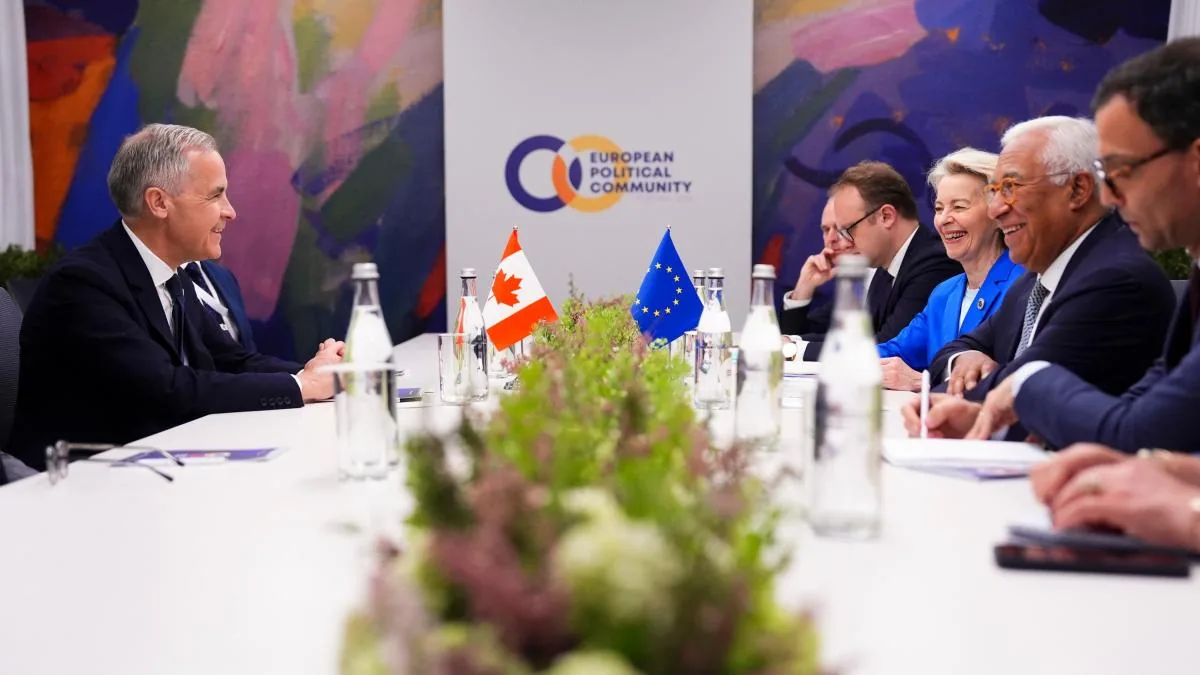
Last week, the European Political Community (EPC) summit held in Armenia had a special guest. It was Mark Carney, the Canadian Prime Minister, who became the first non-European leader to attend a meeting of this intergovernmental forum that since 2022 brings together about fifty countries from the continent.
Read more U.S. considers prosecuting Raúl Castro, whose grandson met in Havana with the CIA director
The liberal Carney, who came to power last year succeeding the popular Justin Trudeau, has quickly cultivated the affections of his European partners and is gaining ground to be seen as a leader capable of standing up to Trump, despite Canada being a country highly dependent on the United States. Since taking office, he warned that he was going to confront him because it was necessary to “stand up to a bully.” His speech at the last Davos Forum in January sparked great interest in Brussels, not only because of its clear and constructive tone but also because of his call for “middle powers” to join forces to defend the rules-based world so despised by the White House occupant. “We must act together, because if we are not at the table, we are on the menu,” he warned from the important Swiss platform.
Unprecedented steps
Canada is the first non-European country to participate in the EPC and the joint arms procurement program
“Canada has a way of looking at the world and solving challenges that Europe largely shares,” explained a senior European diplomat before the Armenia summit. “It is very similar to Europe in the way it views geopolitics and security, and shares the same principles of a rules-based world, anchored in international law and the defense of this order through multilateralism with the United Nations at the center,” this same source summarized. Carney has strengthened this special relationship, something already hinted at by his unusual resume for a politician. He was also the first Governor of the Bank of England who was not born in the British United Kingdom, from where he warned against the economic risks of Brexit. “Europe and Canada are more than like-minded partners: together we are building a global alliance to defend peace, shared prosperity, and multilateralism,” said the President of the European Council, António Costa.
This flirtation is translating into concrete actions. Not only because of the free trade agreement in force since 2017. Also in military cooperation. Since December, Canada is the first non-European country to participate in the SAFE program, the €150 billion instrument to support member states that want to invest in defense through joint purchases. With this agreement, Canadian companies can participate in European military contracts and access preferential financing to develop and supply defense equipment, something important at a time when Ottawa is immersed in a deep rearmament process to reduce its dependence on the United States. Carney has committed to investing 5% of its GDP in defense and security by 2035.
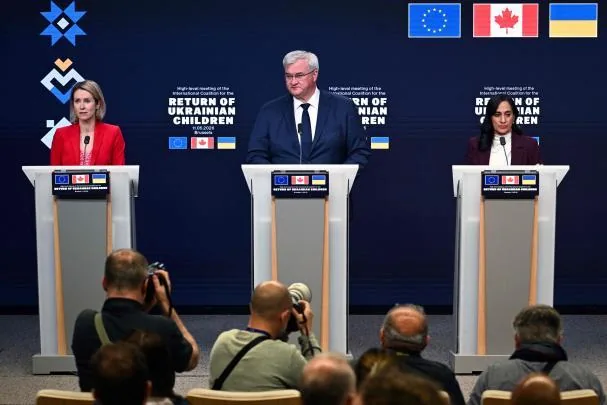
Canada is also aligned with the EU in defending Ukraine against the Russian invasion, and on Monday the Canadian flag was displayed alongside the European and Ukrainian flags at a meeting of the international coalition for the return of Ukrainian children, which Canada organized together with the EU and Kyiv. While the Twenty-Seven sanctioned another 16 people and 7 entities linked to the kidnapping of Ukrainian children at the beginning of the war, Canadian Foreign Minister Anita Anand announced that Canada will impose additional sanctions against 23 people and five entities involved in abuses against Ukrainian children.
The Canadian minister explained during the press conference that the Ukrainian war is one of Canada’s foreign policy priorities and that the country is a firm defender of “territorial integrity and the principles of sovereignty.” A possible jab at Trump, who surprised the world when he said that Canada, its closest neighbor and ally, should become the 51st state of the United States, in what was a threat prior to his latest ambitions to acquire Greenland.
Read more Five Italian divers die in a dive in the Maldives
“Today, Canada is the most European of all non-European countries in the world. And, amid the chaos reigning in the world, Canada and the EU can constitute a stabilizing force in foreign policy and trade,” said the EU High Representative for Foreign Affairs, Kaja Kallas, on Monday before holding the conference for the return of Ukrainian children.
Some are going further. The French Foreign Minister, Jean-Noël Barrot — always very expressive — launched in March the idea that Canada could join the EU in the future, speaking of the appeal the community bloc now has as Iceland is considering formally applying for membership. The President of Finland, Alexander Stubb, also suggested to Carney during a running session that he “should consider” joining the club of the Twenty-Seven.
The 28th Member State?
The French Foreign Minister and the President of Finland suggest Canada should join the EU
Although there is no approach that suggests this possibility is anything more than hopeful statements from some like-minded politicians, the idea is liked on both sides of the Atlantic. A 2025 YouGov Canada poll indicated that 42% of Canadians were in favor of the country becoming the 28th Member State of the EU, a support similar to what the idea would have in France (42%), Germany (55%), Italy (41%), Poland (46%), and Spain (51%).
The former NATO Secretary General Anders Fogh Rasmussen has had another idea: a new alliance of democratic nations capable of standing up to the United States if necessary, also against its economic coercion through tariffs. It would be called “D7” (D for Democracy) and would include the EU, the United Kingdom, Japan, Canada, Australia, New Zealand, and South Korea. So far, neither the EU nor Canada have commented on this proposal.
Read more Lluís Permanyer stays at home