Good morning,
Few presidents of the United States throughout history have been as criticized and directly insulted as Donald Trump is. Many of you will tell me that he has earned it with his actions and decisions. But he remains, on paper, the most powerful man in the world and, therefore, other international leaders usually act cautiously and prefer to get along with him and not create unnecessary slights. It is evident that the Israeli Benjamin Netanyahu has the highest honors in the subject of knowing how to earn his trust. In the current legislature, he has met with Trump at least seven times, in various visits to Washington and Mar-a-Lago, and has managed to align him with his positions.
Read more Iran fires missiles at a US destroyer in the Strait of Hormuz
Another leader who has not hesitated to flatter him publicly and privately is NATO Secretary General Mark Rutte, who believes that the best strategy to keep the United States within NATO is to play along. Recently, at the last Davos Forum meeting, he told reporters: “I know I am not popular among you because I defend Donald Trump, but I really think you can be happy that he is here because he has forced Europe to face the consequences and take more responsibility for its own defense.” Last June, Trump himself posted on his social network a private message from Rutte in which he wrote to him, imitating his way of writing in capital letters: “You will achieve something that NO American president has been able to achieve in decades. Europe is going to pay BIG, as it should, and it will be your victory.” He then finished by referring to him as “daddy” although he clarified that this was due to a translation problem.
The President of the European Commission, Ursula von der Leyen, did not hesitate to go all the way to Scotland to visit Trump at a golf course he owns last July. The same was done by British Prime Minister Keir Starmer. And the latest Nobel Peace Prize winner, María Corina Machado, did not hesitate to give her precious award to Trump, despite the slights he has inflicted on her.
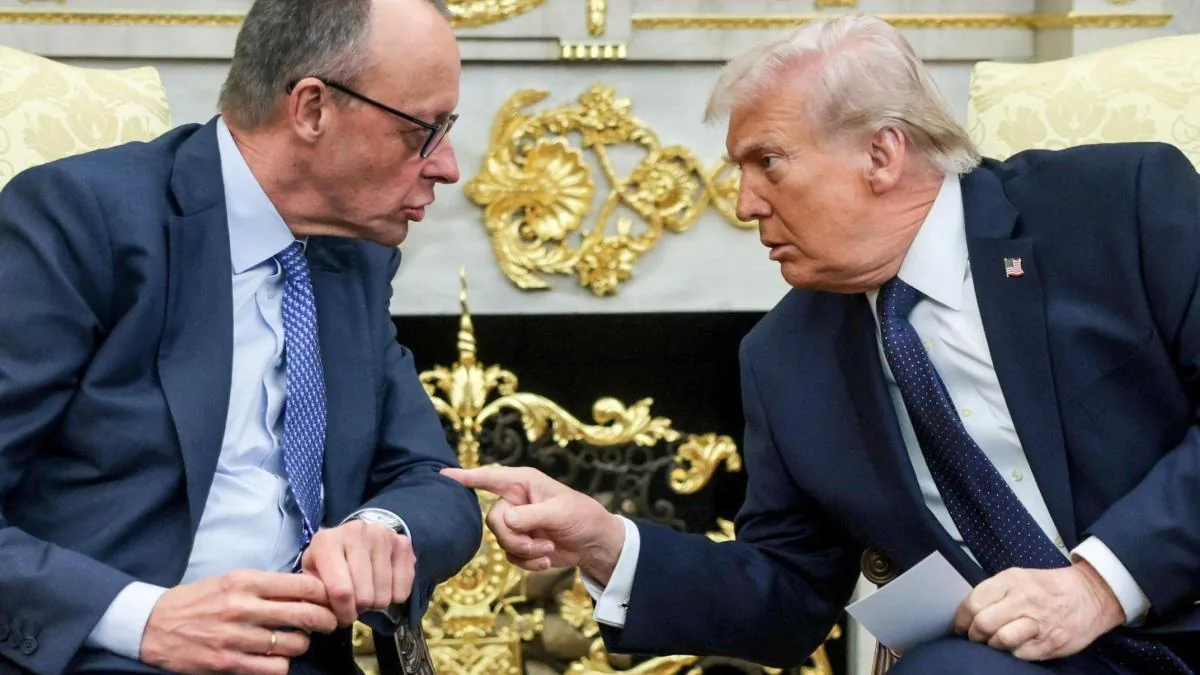
German Chancellor Friedrich Merz has not understood well that Trump sometimes acts like a spoiled child and one must be especially cautious in relations with him and especially in what is said about him. Last Monday, the Christian Democratic politician held a meeting with students in the Rhenish city of Marsberg. The teenagers asked him friendly and innocent questions, a camaraderie atmosphere was created, the usual tension before journalists did not exist, and the chancellor let himself go and, without being very aware, spoke without the usual prudence. Thus, Merz said that the Iranians are “obviously negotiating very skillfully” and are “clearly stronger than previously thought.” So far, so good, but the chancellor got encouraged: “It is evident that the Americans do not have a strategy, and the problem with conflicts like this is always that it is not enough to enter, you also have to know how to get out.” And he added: “They send Americans to Islamabad and let them leave without results. With this, the Iranian regime, and especially the Revolutionary Guard, are humiliating the entire American nation.” And from here to turning this phrase that Iran humiliates Trump into a headline in all the media worldwide. At a time, moreover, when the Republican president does not know how to get out of the mess he has gotten into in the Middle East. Merz did not say any lie, but Trump did not like hearing it at all, especially from a European country that, like the rest, did not want to help him close the Strait of Hormuz.
And two months after the start of the war in Iran, Trump issues very contradictory messages. Last Friday, at a meeting with supporters, he said he regretted nothing and that “he would do it again,” but no one knows how he will resolve this conflict, while energy markets are in chaos and his popularity diminishes more each day six months before the midterm elections. Thus, Americans disapprove of his handling of the situation with Iran by 66% to 33%, according to a survey released today by the Washington Post and conducted by Ipsos. His approval rating on economic matters has dropped seven points, to 34%, due to the sharp increase in gasoline prices. This is a key figure for the November elections.
Returning to Merz, Trump did not take even a week to retaliate against Germany. And so he announced this weekend that he will withdraw about 5,000 soldiers from Germany out of the 36,000 stationed there. Officially, the measure was taken “after a thorough review of the department’s military deployment in Europe and responds to the needs and conditions of the theater of operations,” according to a Pentagon spokesperson. It is very possible that this decision would not have been made if Merz had measured his words more carefully.
And it is surprising because the chancellor was already the protagonist of another controversy with Trump on his last visit to the White House and there it was precisely the opposite, for not putting him in his place. It was the day the Republican president threatened to break all trade deals with Spain due to the decision of Pedro Sánchez’s government not to increase defense spending and not to allow the use of its military bases to bomb Iran. Trump said Spain was “a terrible ally” and Merz agreed by saying Spain should make the effort to reach 5%.
Precisely, if you look at the speeches of the Spanish president, he is very cautious when talking about the United States and Trump. He always places respect for the American nation first, the economic ties that bind them, and only afterward makes his position in favor of peace clear. There is no direct allusion against Trump, as there has been against Netanyahu or Vladimir Putin.
The fact is that, despite all the threats the Republican leader has launched in recent weeks against Spain and, specifically, in favor of dismantling the American bases in Morón and Rota, the reality is quite different. As Joaquín Vera wrote this past Sunday in La Vanguardia, there are various investment projects to improve these facilities and their access. Nothing seems to indicate that the White House will dispense with both enclaves, which have been very useful in the various armed conflicts the United States has had in the Mediterranean and the Middle East. A very different situation from that in Germany, where the deployment of soldiers has been much greater, but influenced in the past by the Cold War concept and the threat of Russia. Today, for the American Administration, within its strategy of distancing from Europe, Putin poses no danger and it considers it makes no sense to have so many troops stationed in the heart of the EU.
It is difficult to predict what may happen in the future, but Trump is extremely practical and Spanish diplomacy is subtle when referring to the American partner. Navigating these relations is not easy and mistakes are common. Merz has experienced it firsthand, right on the first anniversary of his rise to power. As our correspondent María Paz López explains, the German chancellor is not living his best moment.
AS EVERY MONDAY, HERE IS A SERIES OF REFERENCES PUBLISHED THIS WEEK IN ‘LA VANGUARDIA’ THAT YOU CANNOT MISS
Interview by Sergio Heredia with the world marathon record holder, Sabastian Sawe.
Read more South Korea investigates possible attack on a ship in the Strait of Hormuz
And an analysis by Sergio himself on how he managed to break this barrier and an article by Enric Jové about the business behind this record.
Teresa Sesé provides little-known details about Pablo Ruiz Picasso’s Guernica and the possibility that it was influenced by the painter’s personal experience in Málaga.
A visual narrative exercise that recommends where the solar eclipse of August 12 will be best seen and explains the phenomenon.
Joan Esculies reveals an unpublished diary of Francesc Cabana, brother-in-law of former president Jordi Pujol, which is important for the trial currently taking place in Madrid.
Maite Gutiérrez and Fernando H. Valls explain the legal chaos left by the repeal of the rental extension and the limbo in which thousands of contracts are.
The Barcelona Supercomputing Center has launched an open-source chip prototype that is the most advanced in Europe.
The deputy director and Reader’s Ombudsman, Joel Albarrán, has held one of our usual meetings with La Vanguardia subscribers.
The Visual Narratives section has won two awards in the latest edition of the Society for News Design (SND) awards.
Finally, I recommend that this Thursday you acquire the new issue of Vanguardia Grandes Temas dedicated to Antoni Gaudí.
AND THESE ARE MY ARTICLES FROM LAST WEEK:
-Tuesday, April 28: Putting police in classrooms
-Wednesday, April 29: A no for nothing
-Thursday, April 30: Journalism is something else
-Friday, May 1: An absentee society
-Saturday, May 2: Let’s not forget Ukraine
-Sunday, May 3: A pride for Barcelona