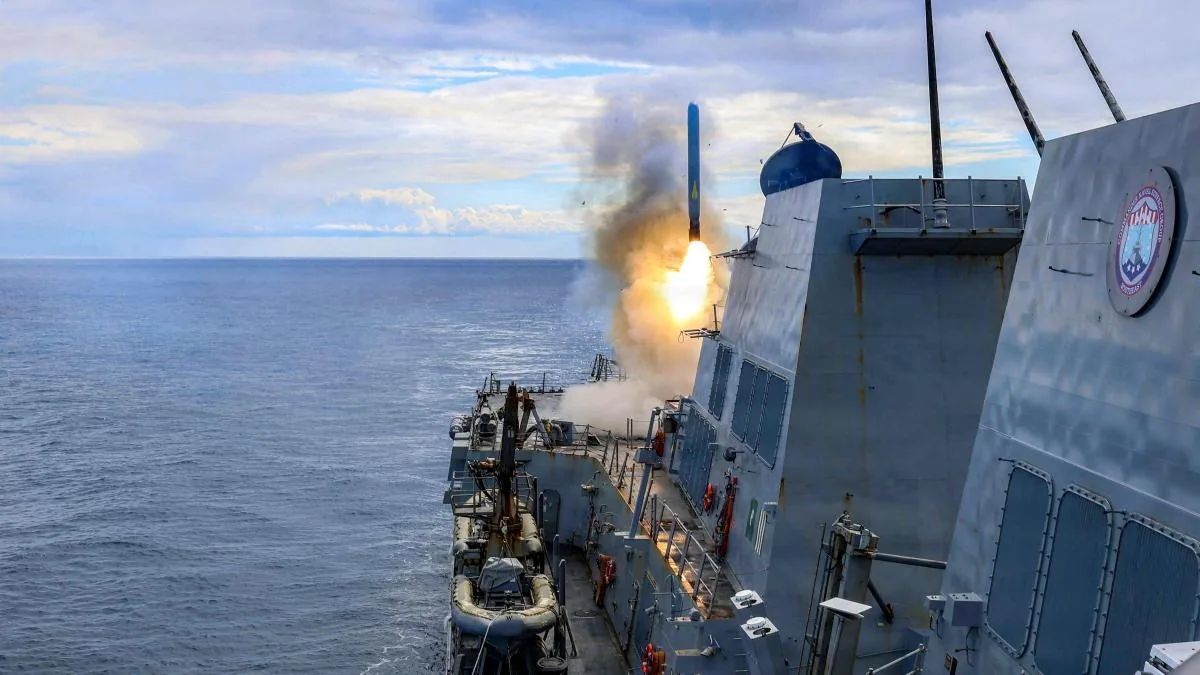
Since the post-World War, the U.S. has launched its wars with fearsome displays of force and cutting-edge technology. Overwhelming victories in the initial battles that, however, end disappointingly. The Korean War ended in a stalemate. In Vietnam, with a humiliating withdrawal. Iraq and Afghanistan, genuine routs. A pattern of lightning tactical victories and strategic defeats whose consequences last for decades.
Read more Isfahán, in the shadow of the nuclear program
The current war against Iran fits this pattern. An apocalyptic initial attack against the Iranian political leadership and army that was supposed to lead to a lightning victory. But more than two months later, the situation has become entrenched and the enemy – poorer, less developed, with a toy army compared to the U.S. and a huge internal division – does not surrender. The blockade of Hormuz is the proof.
The most powerful navy in the world, paralyzed at the wolf’s mouth of the Persian Gulf, unable to reopen the main energy transport route and many other essential products for the global economy. Anyway, in this campaign against Tehran, new elements also emerge that relate both to military matters and to the role of the economy in present-day wars.
Donald Trump has launched a campaign that has revealed that “the U.S. has left itself unprepared for modern war,” according to a critical editorial in The New York Times, in line with many others published these days by other media in the country; including the Wall Street Journal, along with the television Fox News, owned by the president’s reference media mogul, Rupert Murdoch.
For war, industry must be complex and flexible; the U.S. has focused on AI and outsourced the rest
Wars have been conflicts between economic systems for many decades now, especially industrial, complex, flexible, and dynamic ones. And in this area, Iran should be completely outmatched by the U.S. But the spread of dual-use technologies, civil and military, has allowed the development of new weapons, cheap and versatile, lethal in war and within reach of a good number of countries. This has been the case with drones and small mosquito boats, lightly equipped, with which the Iranians attack enemy ships and keep Hormuz closed. Weapons against which the Navy has no reliable interception and security systems. The pretentious Silicon Valley technology is receiving, in the first war of the artificial intelligence era, a lesson in humility. The mirage of absolute technological control by Peter Thiel and Alex Karp’s Palantir will have to wait until it is perfected.
The U.S. Navy has experienced in Iran the ordeal that the Russian army has been living through for four years in Ukraine. A handful of drones, each valued at around $30,000, have destroyed facilities and equipment worth tens of millions. Some Iranian missile has disabled a radar, like the AN/FPS-132, which costs $1.1 billion, blinding vital control and surveillance systems. According to CNN, most U.S. bases in the area, up to 16 of them, are damaged or out of service due to drone and missile attacks, exposing the security of those supposed fortresses. It seems that the spells of the ineffable U.S. Secretary of Defense, Pete Hegseth, appealing to the warrior ardor and the virile spirit of his troops will not be of much use.
Read more Meanwhile
What the U.S. army would need now is to develop new weapons to effectively face those threats. A challenge that adds, in the short term, to the need to stock up on more ammunition, as their supplies run out. Even with a longer perspective, thinking about its growing antagonism with China, Washington should increase its war fleet if it wants to continue controlling the main trade routes. (The Arctic thaw also demands more ships).
Adapting to new forms of war requires, besides a lot of time and more money, having a diverse and flexible economic/industrial system. But since the U.S. economy has specialized in certain areas of the economy – those related to new technologies, in which it is a world leader, and especially in AI – and has practically abandoned classical industry, the effort will be enormous.
“The U.S. has left itself unprepared for modern war,” according to ‘The New York Times’
To build ships, shipyards and specialized workers over generations are needed. Something that no longer exists in the country, barely a small garrison of fleet maintenance companies. The same goes for developing drone production and defenses against enemy drones. China, the world’s factory, is already the world’s largest producer of drones and their components; it controls 90% of the commercial ones. Ukraine and Russia receive essential components from Beijing to build the ones they use. Meanwhile, Iran, since last June’s bombing, has revealed an unexpected industrial capacity to replenish its arsenals, which some experts estimate still at 40% of what they were before the war began. And that the U.S. has not been able to match.
Trump has asked Congress for a military budget of $1.5 trillion for next year, 40% more, and that figure does not include the costs of the Iran war, which officially total $25 billion, a figure specialists believe is lower than the real one. But that plan does not include the costs of regenerating the industry to boost arms production. Thus, a war whose causes have not been explained to either Americans or the world will be another twist in the militarization of society and will generate more problems for a global economy more fragile after the Hormuz crisis. The U.S. will have to go into even more debt and Europe and the rest of Washington’s Western partners will pay the final bill.
Read more Harassment in the supermarket