Now comes the second part of the no to war. Now come the bills and reprisals for not having unconditionally supported the United States. The economic bill of the war is yet to be determined. It is the great global unknown at the moment. Germany has just received the first blow, after Chancellor Friedrich Merz , initially favorable to the offensive against Iran, declared this week that Donald Trump has fallen into a trap set by the Iranians and does not know how to get out of it. Five thousand American soldiers will be withdrawn from Germany, and the tariff on European cars will rise to 25%. Germany is at a critical moment: while rearming, it has just announced cuts in healthcare and the pension system to rationalize spending, according to the official version.
Read more Harassment in the supermarket
There will surely be reprisals against Spain, but it is unlikely that the United States will abandon Rota, a strategically important enclave in which Washington has invested a lot of money, as explained by Joaquín Vera today in La Vanguardia.
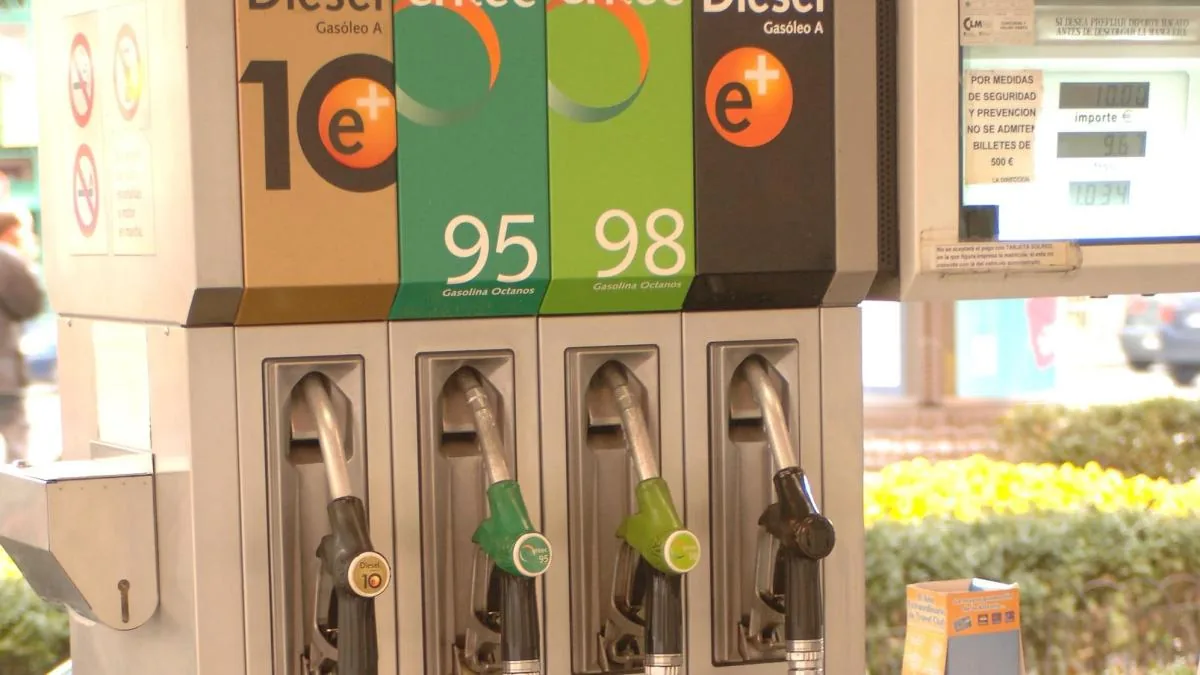
There will be an economic bill for the closure of Hormuz, but we still do not know its amount. It could be a monumental crisis or a temporary cold. The United States can operate without Persian Gulf oil, but Trump did not promise war and inflation to his voters. We are in the meantime.
Meanwhile, it is interesting to observe the chart that political scientist Oriol Bartomeus has been preparing on the support of the main Spanish political leaders among their voters. It is a chart that shows the nerve of each of them and its evolution, month by month, since September 2023, with CIS data that have nothing to do with the voting projection, which is always subject to discussion.
The no to war has strengthened Sánchez among his voters, now comes the second part
With the no to war, Pedro Sánchez has regained strength among PSOE voters, approaching a preference of 70%; almost the same capital he had at the start of the legislature, when he managed to prevent Alberto Núñez Feijóo from having a parliamentary majority to govern Spain. He does not have the elections won, he will very likely receive a blow in Andalusia, but he has regained nerve.
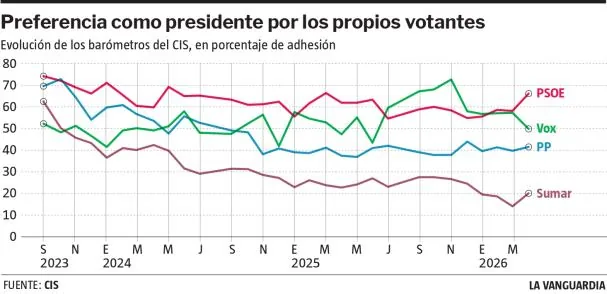
Sánchez rises and Santiago Abascal falls, who had reached over 70 among his own. It is interesting to observe the sharp sawtooth pattern that Abascal’s leadership presents. It goes up and down constantly. Vox is an eminently reactive phenomenon. Is Abascal paying these weeks for his blind adherence to Trump, or the mess that Iván Espinosa de los Monteros and Javier Ortega Smith have caused him in Madrid?
Read more Trapped in the burofax after the fall of the decree to extend the rentals
Núñez Feijóo is much more predictable. He started to decline two years ago and remains on a plateau below 50. We are talking about the little enthusiasm he arouses among Popular Party voters. It is a data related to nerve. With that gray tone, one can win general elections. Feijóo does not want to excite, he wants to crush Sánchez; he wants to be able to build a majority. Once that majority is achieved, the BOE will take care of the rest. He wants to correct the results of July 23, 2023, which he has always considered an accident. The brief rebound of Yolanda Díaz stands out, driven by the anti-war and anti-Trump climate. It is ironic that Díaz improves her position after having announced that she is retiring.
Conclusion: the National Preference bloc could govern Spain in the coming years, but the war is not favoring it in terms of political passion. That bloc could again lose its majority if its voters demobilize by two or three points. This helps explain the political climate in Spain. Tension is needed. People like Vito Quiles work for that.
Meanwhile, the bill is being written. Oil closed the week at 120 dollars a barrel. If that price were maintained, the strangulation of Hormuz would have very strong consequences. It is the trump card of the Persian warriors. Hold on until Trump cannot bear the internal electoral pressure derived from inflation.
Meanwhile, the United States has just received good news: OPEC has entered into crisis. The United Arab Emirates, supporters of increasing oil production, even if it means lowering the price, have just left the cartel, with the purpose of breaking Saudi Arabia’s restrictive strategy. The country of the seven emirs has a pipeline that allows it to bypass the Strait of Hormuz and transport oil (between one and two million barrels daily) to the Gulf of Oman, outside the bottleneck.
Germany receives the first blow from the United States; Spain is on the list
We do not know what will happen. The Government says it has a specific reserve of 3.5 billion euros to contain the rise in fuel prices. There will be an important test in summer: Spain, a refuge country, could have a great tourist season if there is enough kerosene for planes and tickets do not become more expensive. The season will speak in summer.
Read more The repeal of the rental extension leaves thousands of contracts in legal limbo