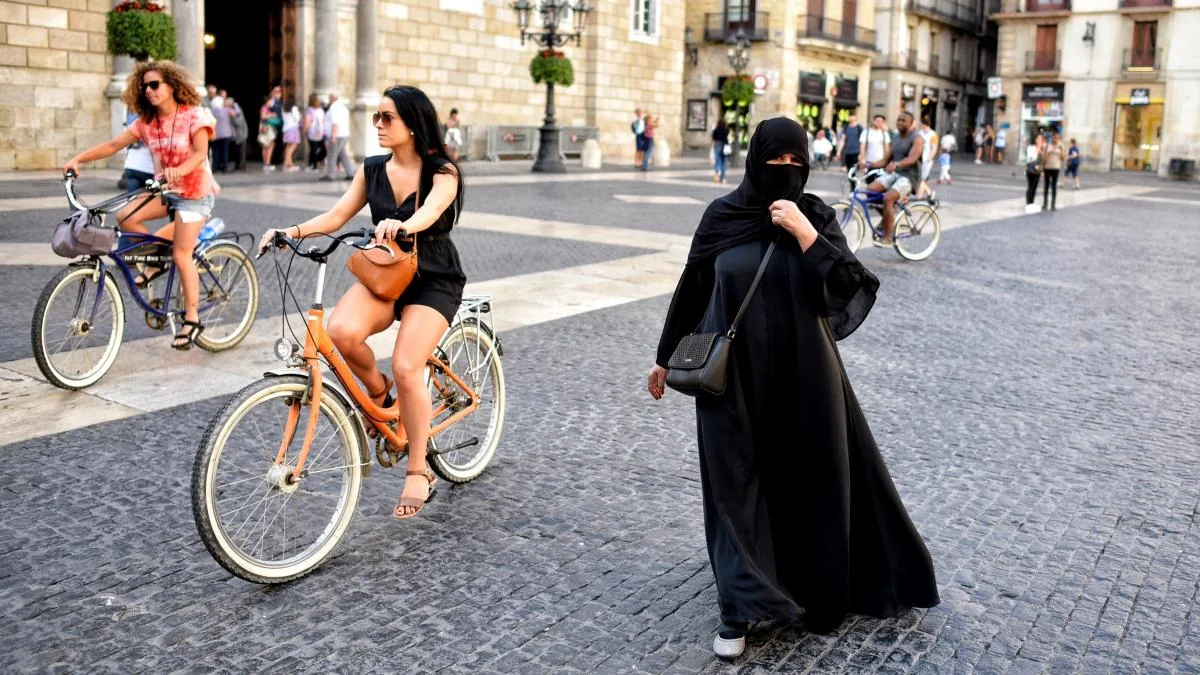
“The fact that it has never happened does not mean we are not prepared when it does.” The phrase, from a Vox spokesperson, does not refer to the prevention of a health or climate emergency, but to the possibility of a woman dressed in a burka or niqab entering public offices. Specifically, in the Diputación de Valencia, the latest institution to join this week the several dozen town halls, half of the regional parliaments, and even the Congress itself, which have voted on initiatives promoted by the far right against the use of the full Islamic veil (burka or niqab) in public buildings. The texts – of which only half have succeeded – mostly urge the Government to legislate on the matter, as it is a state competence. But the left refuses to ban the veil, for reasons of religious freedom and because there are no burkas in Spain and the niqab is a minority.
Read more Let’s not forget Ukraine
So what does Vox gain with an initiative destined to fail? And what is a party with such a conflictive discourse on feminism and immigration doing talking about freeing Muslim women from a “cloth prison”?
Well, Vox knows well what it is doing because, to begin with, it gains media presence. Since February, it has been rare for a week to go by without the burka issue being debated in some institution, which has allowed the far right to set the local or regional political agenda and at the same time generate a sense of social urgency by presenting the initiative on several consecutive fronts.
Secondly, Vox forces other parties to take a stance on a complex issue that is not part of the common conversation, while also seeking to differentiate itself from the PP, with whom it competes for a type of voter concerned about immigration, especially of Muslim origin. As in other initiatives, what the PP has done is join Vox’s strategy, voting in favor of the motions, in some cases lowering the content, for example by removing sanctions or establishing that entry with a veil will be allowed if the woman shows her face when asked.
Laura Mijares, professor in the area of Arab and Islamic Studies (UCM)
“Although there are women pressured by their environment, it cannot be the only interpretation”
The left has also had to take a stance and has done so by systematically voting against these motions, defending religious freedom or acknowledging that the veil is a non-issue in most of the country. “I don’t know how many women you have seen wearing a burka in Burgos,” argued a local PSOE spokesperson.
However, in Lleida, whose town hall was a pioneer in 2010 in banning the burka in public spaces – an ordinance annulled by the Supreme Court in 2013 – it was a socialist mayor – as then – who broke party lines last week by promoting an ordinance that prohibits covering the face in public offices. The PSC and the Generalitat, which clearly distance themselves from the ultra party Aliança Catalana, have avoided censuring the mayor.
The burka debate is, of course, too complex to be addressed with a municipal ordinance, but Vox’s opportunism must be acknowledged. The carousel of motions has run parallel to the electoral cycle that opened in December in Extremadura and closes this month in Andalusia, linked to the PP and Vox pacts in regional governments.
Juan Iglesias, professor in the Sociology department at the Pontifical University Comillas
“Stirring up the dynamic of the native us, group, against them always yields electoral returns”
Why does Vox emphasize the burka? “The offensive focuses on the garment that generates the most rejection and about which there is the greatest social prohibition consensus,” explains Laura Mijares, professor in the area of Arab and Islamic Studies at the Complutense University of Madrid (UCM). In recent years, she points out, the full veil “has been instrumentalized, the women who wear it victimized, and Muslim people as a whole criminalized.”
Mijares emphasizes that this “electoral agenda based on exclusion” occurs in a context where Islam functions “as a powerful signifier that condenses fears associated with security, cultural identity, and demographic changes” and allows “simplifying complex debates and mobilizing strong emotions.”
Read more The question of Germany
Juan Iglesias, professor in the Sociology department at the Pontifical University Comillas and migration researcher, agrees: “The burka debate is absolutely artificial, made to highlight the supposed threat posed by Muslim immigration and its lack of integration, which is not real.” Iglesias stresses that the attitudes of the Spanish population towards immigration and relations between both groups at the local level in Spain are good and there is also a clear structural need for immigration, for economic, demographic, and care reasons.
Laura Morales, research professor at the Institute of Policies and Public Goods of the CSIC
“Where it has been analyzed, the most reactive to the veil are not Catholics, but always atheists”
However, she points out that when there are real social problems, as in Spain, “due to the precariousness that has been consolidating for a lot of people, not only immigrants but also natives, the cost of living or cuts in the welfare state, some political parties always try to find easy solutions and blame immigration in this case,” and then defend the continued cutting of social policies. Iglesias maintains that “stirring up that dynamic of the native us, with a clear, homogeneous, group identity, against them” always yields electoral returns.
That dynamic is fought “by putting people in contact in real contexts, not talking about stereotypes and accusing,” says this expert, who points out that “when you put people to talk and the problems are common, as usually happens, surely all that facet of cultural diversity that is emphasized again and again disappears, even if it exists.”
Laura Morales, research professor at the Institute of Policies and Public Goods of the Spanish National Research Council (CSIC), emphasizes this aspect. “The discursive polarization seen in political elites does not correspond to a growing polarization among the population,” she assures. On the contrary, in her studies with surveys over the last twenty years, a “gradual and progressive greater consensus on the benefits of immigration” is detected, which at this moment translates, for example, into a majority of Spaniards supporting the current regularization.
Regarding the use of the veil, she notes that in countries like France there are studies that seem to show that “the more rejection there has been of the hijab, in schools or in public spaces, there has been an increase in young people who wear it, as a certain form of rebellion.”
Arabist Laura Mijares points out that these garments “share a meaning that refers to the commitment of those who wear them to a certain conception of morality and conduct in public space.” The decision to cover oneself does not respond to a single reason but may involve religious, spiritual, social, or political commitments, or several of these at once.
Regarding freedom of choice, although she points out that “there may be situations in which some women are conditioned or even pressured by their family or community environment regarding their way of dressing,” she indicates that “the problem arises when this possibility becomes a general assumption or the only lens of interpretation.”
Is there a PP-Vox struggle for the Catholic vote?
The PP is the party in Spain that has traditionally had, and has, the highest percentage of voters who declare themselves Catholic. While in the general population Catholics (practicing and non-practicing) are about 50%, in the PP they exceed 80%, Vox is around 70%, and the PSOE about 50%. Given the PP-Vox competition on several fronts, the offensive against the Islamic veil could be a strategy of the ultras to gain Catholic electorate. Laura Morales, research professor at the Institute of Policies and Public Goods (IPP) of the CSIC, is not so sure. In Spain, she points out, there are no studies that ask very refined questions about the valuation of certain Muslim garments, but in other countries, such as Germany or the Netherlands, what is shown is that those who react most against the hijab (the headscarf) are atheists, who have developed a reaction from the point of view of their social and cultural values to all forms of religion. She also points out that Vox has a somewhat ambivalent relationship with the Catholic Church and it is not clear that its current strategies can guarantee it the block of more traditional Catholic voters.
Read more It’s not that time heals everything